•
3 min read
Compare the best sales demo software for interactive demos, personalization, and buyer engagement. See which tool fits your sales process.

Key Takeaways
Hobbes is the top pick for B2B SaaS teams that want every website visitor demoed, qualified, and booked without a form: an AI Sales Employee that runs a conversation, demos an interactive sandbox replica of your product, and scores against your ICP, 24/7.
Storylane is the best all-round interactive demo builder for teams whose reps and marketers need to create and share demos across outbound, live calls, and the website. Free tier, fast creation, three capture formats.
Navattic is best for marketing teams embedding high-fidelity click-through tours with deep step-level analytics.
Walnut is best for sales-led teams that personalize demos per account for live calls.
Consensus, Reprise, and Demostack fit enterprise presales orgs with dedicated solutions engineers. Arcade and Supademo fit small teams that need polished demos fast and cheap.
A sales engineer posted in r/salesengineers with three weeks to find a tool for automated product demos.
He needed two kinds: one his reps could run on live calls, and one prospects could click through on their own.
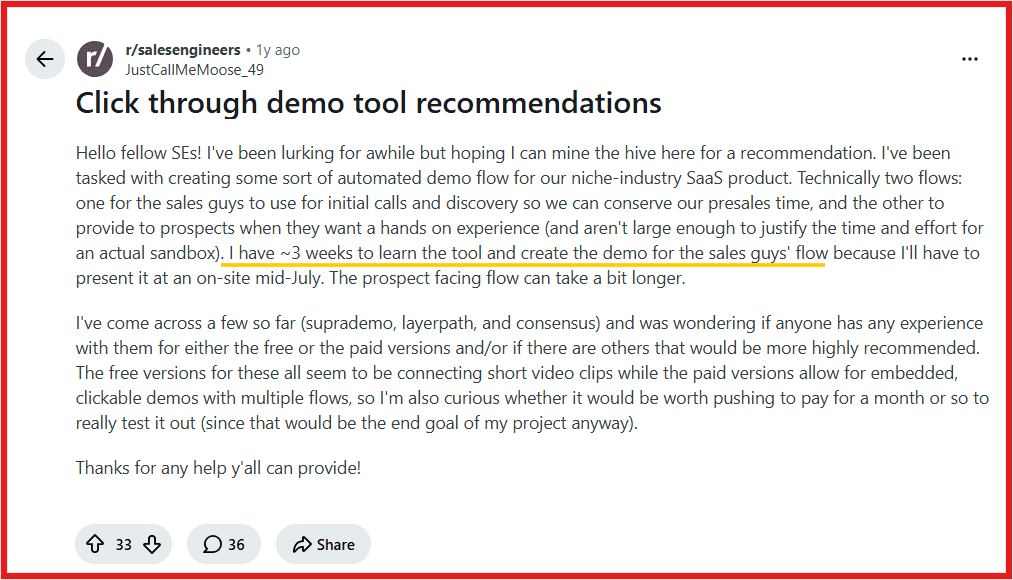
Within hours the thread turned into a vendor pile-on: Navattic, Consensus, Storylane, Walnut, Supademo. That thread is the sales demo software market in miniature.
The category now covers five jobs: click-through tours, video demo libraries, sandbox environments, sales-led personalization, and AI-led conversational demos that run without a rep. Pick the wrong type and you've paid for a tool nobody uses.
Below, we compare nine sales demo tools on pricing, features, what real users say, and who each is built for.
Best 9 Sales Demo Software in 2026: Quick Comparison
Every tool in this article, side by side, is ranked by the size of the problem it solves for a SaaS team.
Hobbes is our product, so we say who it's wrong for as well as who it's right for; the full method is in how we selected these tools below. Pricing comes from each vendor's own pricing page or documentation as of September 11, 2026.
Vendors change plans often, so confirm before you buy.
Tool | Type | Standout feature | Pricing | Best for |
Hobbes | AI Sales Employee (interactive conversational demo + qualification) | Buyer clicks a live sandbox replica while Hobbes answers, qualifies, and books | Quote-based (Starter, Growth, Scale, Custom); contact sales | Mid-market B2B SaaS with a product that needs explaining |
Storylane | Interactive demo platform (screenshot, video, HTML) | Fastest path from capture to published demo, plus RepX AI agent add-on | Free; Starter $40/seat/mo (annual); Growth $500/mo; Premium $1,200/mo; Enterprise custom | Cross-functional SaaS GTM teams |
Navattic | HTML interactive tours | Step-level analytics and account identification | Free (1 demo); Startup $125/mo; Base $500/mo; Growth $1,000/mo (all annual); Enterprise custom | Marketing-led tour programs and ABM |
Walnut | Sales-led interactive demos | Per-account personalization with approved templates | Ignite $575/mo; Accelerate $1,550/mo (both annual); Scale custom | AEs running personalized live demos |
Consensus | Video-led demo automation | Demolytics: buying-committee visibility | Not published; contact sales | Enterprise presales, multi-stakeholder deals |
Reprise | Enterprise sandbox platform | Three fidelity levels: Replay, Replicate, Reveal | Custom / not public | Solutions engineering teams with complex products |
Demostack | Full front-end product clone | Realistic, consistent demo environments across reps | Custom / not public | Large sales orgs standardizing live demos |
Arcade | Screen-recording-first demo creator | Record once, output demo, video, and GIF | Free; Growth $42.50/seat/mo (annual) or $50 monthly; Enterprise custom | PLG and product marketing launches |
Supademo | Budget interactive demo builder | Lowest entry price; AI builds a walkthrough from a URL | Free (5 demos); Scale $38/creator/mo; Growth $350/mo (5 creators), both annual; Enterprise custom | Small teams and help-center demos |
One tool on this list replaces the demo request form itself, not just the demos your reps build.You can watch Hobbes demo itself right now, no form and no calendar link needed.
1. Hobbes: Best for Interactive AI-Led Conversational Sales Demos
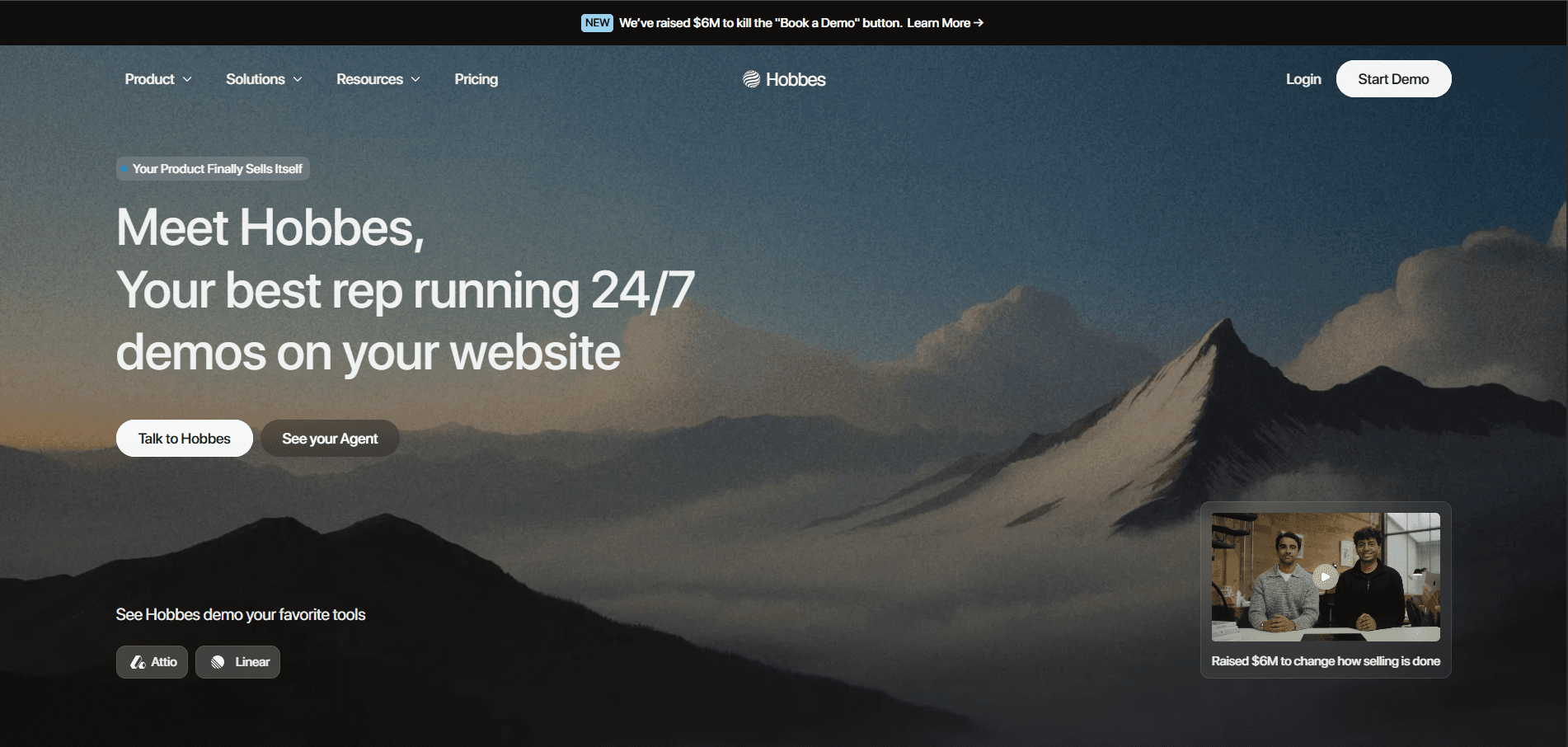
Hobbes is an AI sales employee, and the one entry here that's not a demo builder. It belongs to a different category, agent-led growth: instead of publishing a demo and waiting for a form fill, you put an agent on your website that runs the first sales call for every visitor. The agent turns traffic into pipeline. Not the form, and not a rep.
The buyer asks questions in a conversation. Hobbes answers while surfacing the relevant screen in an interactive sandbox replica of your actual product, researches the visitor's company live, scores the contact against your ICP, and offers a calendar or checkout the moment intent is clear. All of it 24/7, in the buyer's language, without a form.
That's a different job from the tour builders on this list. Storylane and Navattic help reps and marketers create demos. Hobbes replaces the demo request form and the first qualification call.
We ranked it first because that form is the biggest bottleneck in most SaaS funnels: it converts around 1.8% of visitors, and about 60% of the companies we talk to have no demo tool at all. Reps who build and send their own demos should look at Storylane next.
Hobbes Key Features
Three capabilities separate Hobbes from a click-through tour: the sandbox replica, the conversation and qualification layer, and the self-improving loop.
#1. Interactive Sandbox Replica
Hobbes builds a working replica of your product from your docs, help center, sales decks, recorded sales calls, and live product capture. Buyers open it and click through the real features themselves, at their own pace.
When a buyer asks "can this sync to Salesforce?", Hobbes answers and opens the integration screen at the same time.
Because it's a live replica rather than a captured path, the experience is fully dynamic: the buyer or the agent can take a tailored route through the product, so a RevOps lead and a CFO from the same company see two different demos.
No two feel the same. This is the hardest thing in the category to copy, and it's why Hobbes fits complex products that take real explaining, the kind where planning a SaaS product demo usually eats a rep's afternoon.
#2. Live Buyer Research, ICP Scoring, and Routing
While the conversation runs, Hobbes researches the visitor's company, shows the use cases built for their role and stack, enriches the contact with LinkedIn, phone, and company data, and scores the buyer against the ICP criteria you set.
When intent is clear it offers a calendar or checkout and routes to the right rep. Structured context lands in HubSpot, Salesforce, Attio, Pipedrive, Slack, email, webhooks, the API, or MCP servers.
Reps only meet real buyers, and they open the call already knowing what was asked and what objections came up. Because the demo adapts to each buyer, that context is specific, not a generic transcript.
#3. The Self-Improving Loop
"Self-improving" means four specific behaviors. Before launch, Hobbes runs simulations against real buyer scenarios. It flags questions it can't answer instead of guessing. It re-reads your docs and help center as they change, and it remembers returning visitors, sharpening with every conversation.
Tours go stale the day your product changes. Hobbes reads the changelog. We break down how the self-improving loop works and why continuous learning matters more than launch-day accuracy.
best 9Hobbes Pricing
Hobbes does not publish dollar pricing. All four tiers are quote-based and include managed implementation: training, simulations, evaluations, and ongoing optimization.
Plan | Price | Notes |
Starter | Contact sales | Managed onboarding included |
Growth | Contact sales | Higher conversation volume, more integrations |
Scale | Contact sales | Multi-region, localization, advanced routing |
Custom | Contact sales | Data residency, custom DPA, SSO via SAML/OIDC with SCIM |
Typical time to value is days, not quarters: train, simulate, launch, improve.
Where Hobbes Shines
The buyer drives the real product: Every other tool here plays a path someone built. With Hobbes the buyer clicks an interactive sandbox replica of the actual product and asks the question the tour didn't anticipate. The replica is the hardest thing in the category to copy.
No two demos feel the same: The route through the product is built around each buyer's role and questions, so a RevOps lead and a CFO from the same company see different screens in a different order. Every answer arrives with the product on screen.
Qualification, not engagement: Enrichment, ICP scoring, and CRM routing come standard. Digit saw human demo bookings rise more than 50% in the first 30 days after replacing its free trial with Hobbes, and CRO Simon Kronenberg reports the buyers who booked arrived better qualified.
Coverage without headcount, and no build project: 24/7 in any language: Hobbes translates both the conversation and your product's UI into the buyer's native language, using the terminology each region uses. No lead waits overnight. Implementation is managed: Hobbes is live in days, with simulations, evaluations, and ongoing optimization included, and it keeps improving on its own (simulate, flag gaps, re-read docs, remember buyers) rather than waiting for a rep to rebuild it.
Where Hobbes Falls Short
Hobbes is built for products that need explaining: For a product a buyer can grasp in 30 seconds, the conversation is overkill, and Supademo or Arcade will serve you better.
Hobbes needs an internal owner: Someone on your side has to provide product access and source material, review what the agent is allowed to claim, and read the simulation results before launch. Teams that want an unreviewed agent making unrestricted claims are a bad fit.
Hobbes is not a tour builder for outbound: Hobbes Links lets you send personalized demo links in sequences and follow-ups, but if your primary job is reps assembling leave-behinds for email, Storylane or Walnut is the simpler buy.
Hobbes Customer Reviews
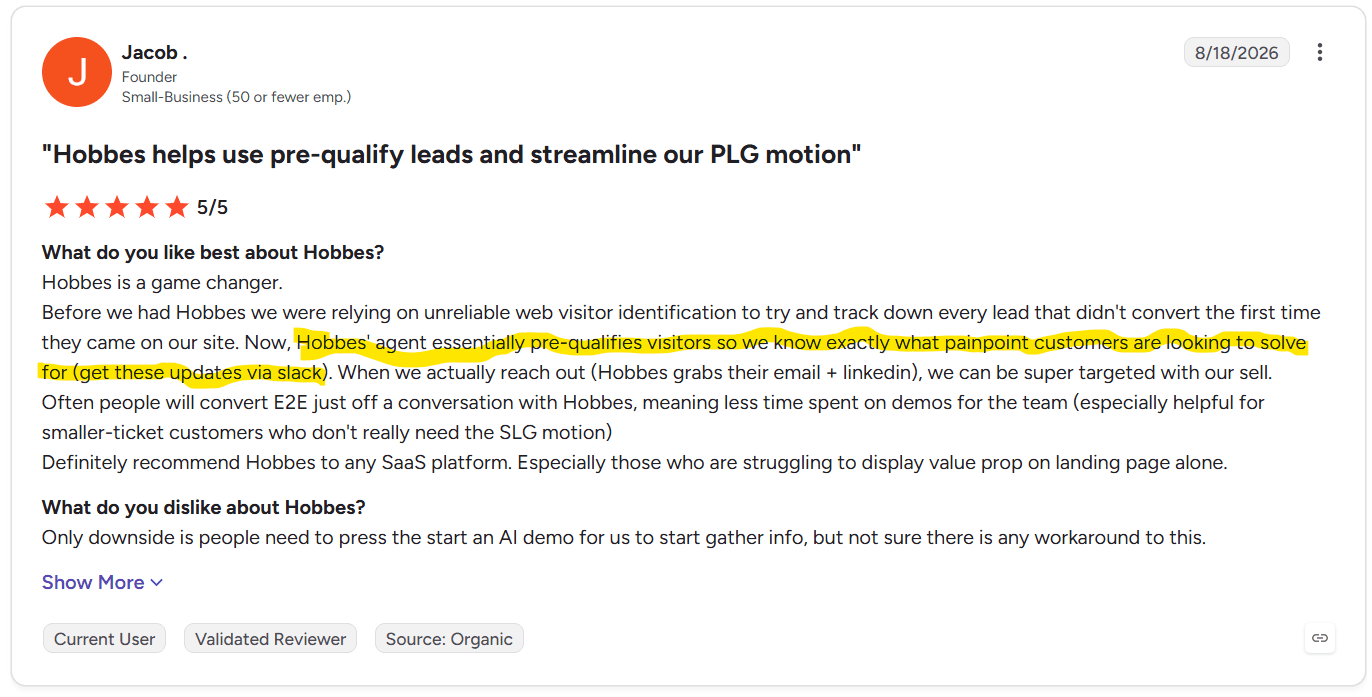
“Hobbes is a game changer”, says Jacob, a validated reviewer on G2. Jacob uses the Hobbes agent to pre-qualify visitors so he knows exactly what painpoint customers are looking to solve for.
Hobbes helped Digit, an ERP vendor for manufacturers and distributors, increase human demo bookings by more than 50% in the first 30 days after it replaced its free trial with an agent, with 2x fewer low-intent signups and a launch in under 14 days.
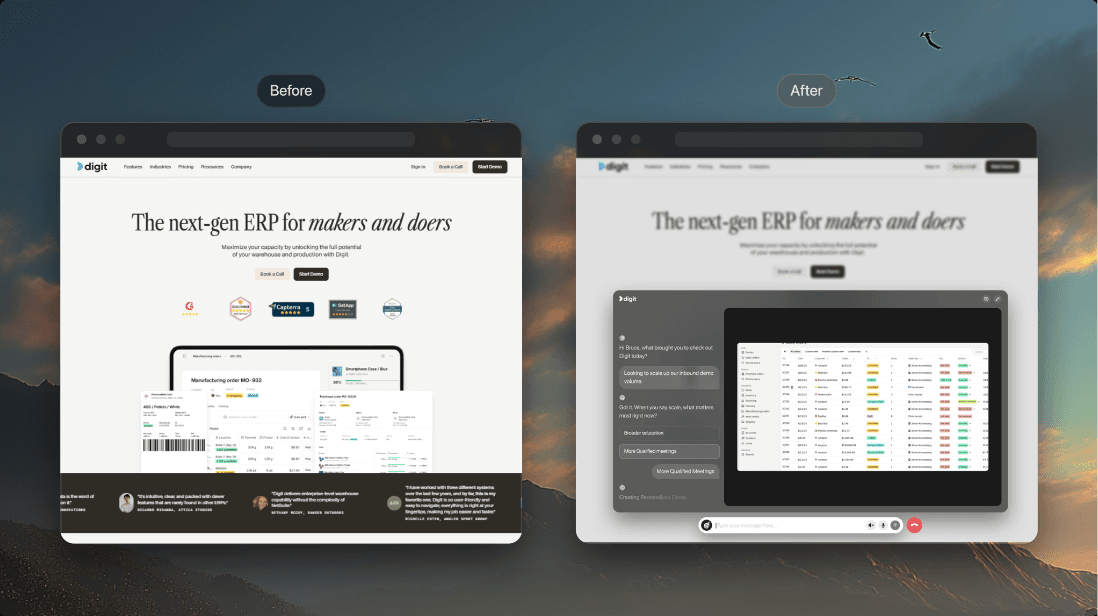
According to Simon Kronenberg, CRO at Digit, "Our goal was not to replace our humans, but make them as busy as possible with as many qualified demos as possible."
For HyperSpell, Hobbes doubled revenue in six weeks by automating the first demo.

Read more customer stories from happy Hobbes customers.
Who Hobbes Is Best For
CMOs, VPs of Marketing, and Heads of Growth at B2B SaaS companies with 51 to 5,000 employees and $5K+ ACV who want the demo conversion rate to move. This is the inbound motion agent-led growth was built for.
Sales leaders running a demo-heavy motion: CROs and RevOps teams whose reps burn hours on first calls that go nowhere, and who want context-rich CRM handoff. The ROI of demo automation shows up first in reclaimed rep hours.
Teams with international or off-hours traffic: Pipeline can land at 2 a.m. or in another language, an AI sales agent is the only thing that answers it.
2. Storylane: Best All-Round Sales Demo Software for SaaS GTM Teams
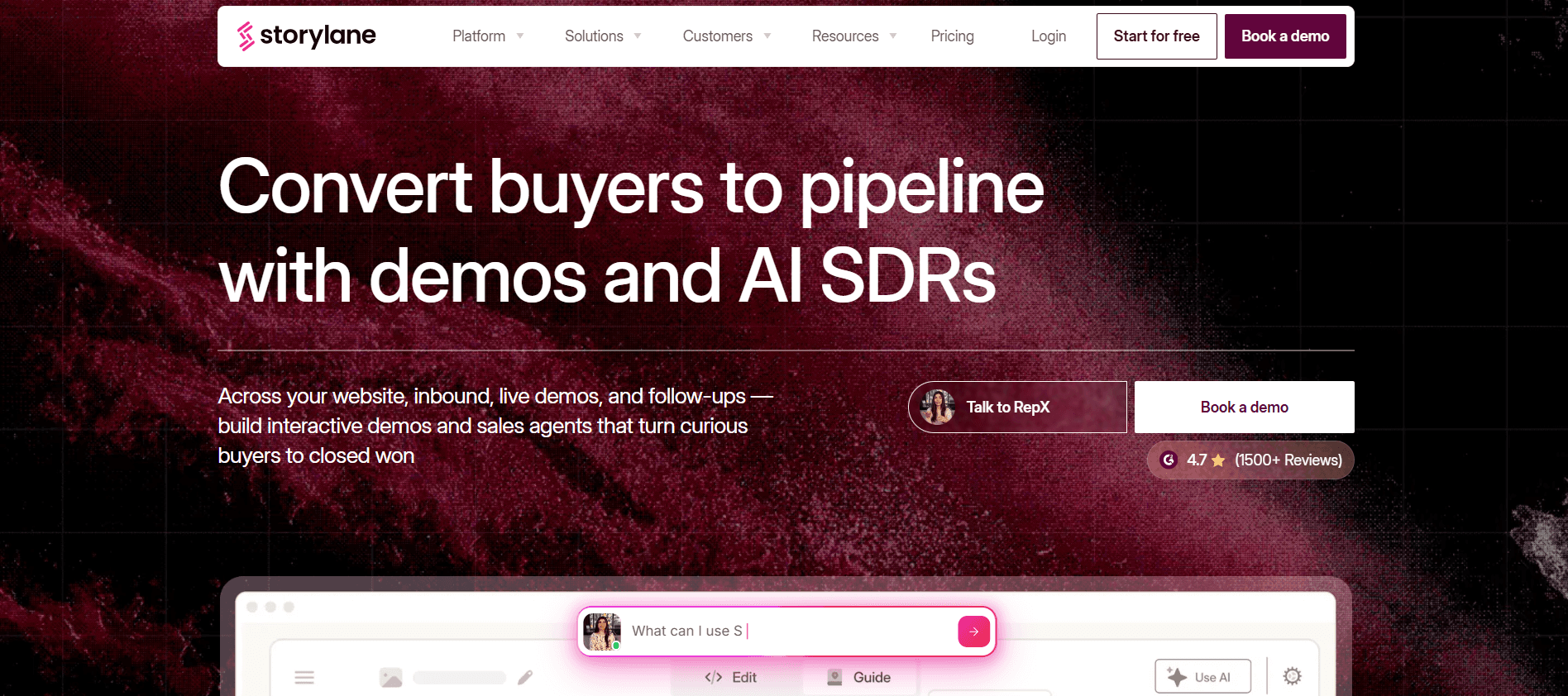
Storylane is one of the two most-reviewed demo automation platforms on G2 and the most complete interactive demo suite for teams that need marketing tours, sales leave-behinds, and presales demos from one tool. If reps building and sending demos is your primary job, start here.
You capture your product as screenshots, video, or HTML, edit without code, and publish in minutes. In 2026 it added RepX, an AI agent that can talk to website visitors and walk them through a demo, sold as a separate product line.
Key Features
Three Capture Formats in One Editor: Screenshot capture for speed, video for narrated flows, and HTML capture for click-through demos that behave like the product. HTML editing is a Growth-tier feature.
Demo Hubs and Personalization: Group demos by persona or use case, personalize text and data fields per account, and share via link or embed. Buyer Hub is a paid add-on.
CRM Sync and Step-Level Analytics: Native HubSpot, Salesforce, and Marketo integrations push demo engagement into your pipeline. Analytics show completion and drop-off by step.
Pricing
Plan | Price (annual billing) | What you get |
Free | $0 | 1 published demo, unlimited views, Storylane branding |
Starter | $40 per seat/month | Unlimited screenshot and video demos |
Growth | $500/month (5 seats included) | HTML capture, personalization, HubSpot |
Premium | $1,200/month (10 seats) | Salesforce, SSO, white-label |
Enterprise | Custom | Sandbox demos, dedicated support |
RepX AI agent | From $2,000/month, separate | Conversational agent on your site |
Monthly billing runs about 20% higher. Core plan prices per Storylane's published plans, September 2026.
Where Storylane Shines
Format versatility: It's the only tool here that handles screenshot, video, and HTML capture at accessible pricing, so marketing and sales can share one platform.
Transparent pricing with a real free tier: You can test it today without a sales call.
Where Storylane Falls Short
Feature gates add up: HTML capture sits at $500/month, Salesforce at $1,200/month, and RepX is a separate $2,000/month line. A two-person team that needs HTML pays for five seats.
The buyer follows a path someone built: Demos in the core suite play the flow you designed. Conversation and qualification exist through RepX, but that's a second product with its own budget.
Customer Reviews
James D., a Senior Director of Product Go-To-Market, wrote on G2 that Storylane's "Time saved" tracker showed his team avoided more than 600 hours of live calls in 12 months by sending demos instead, and Katherine L., an AE, clones and personalizes a demo per prospect in under 20 minutes.
The complaints cluster around price. Jesse J. in Operations noted on G2 that HTML demos require the Growth plan at "10 times the cost" of Starter, and a verified Education Management reviewer said HTML demos render so poorly on phones that the team now adds "best viewed on desktop" to every outreach email.
Who Storylane Is Best For
Cross-functional GTM teams: Marketing wants website tours, sales wants leave-behinds, and both need one login.
Teams that want to start free: Validate demo content before committing budget.
Buyers who want conversation later: RepX is there when you're ready to pay for it.
→ Read more: If Storylane is on your shortlist, we compared the best Storylane alternatives head to head.
3. Navattic: Best for Marketing-Led Interactive Tours With Deep Analytics
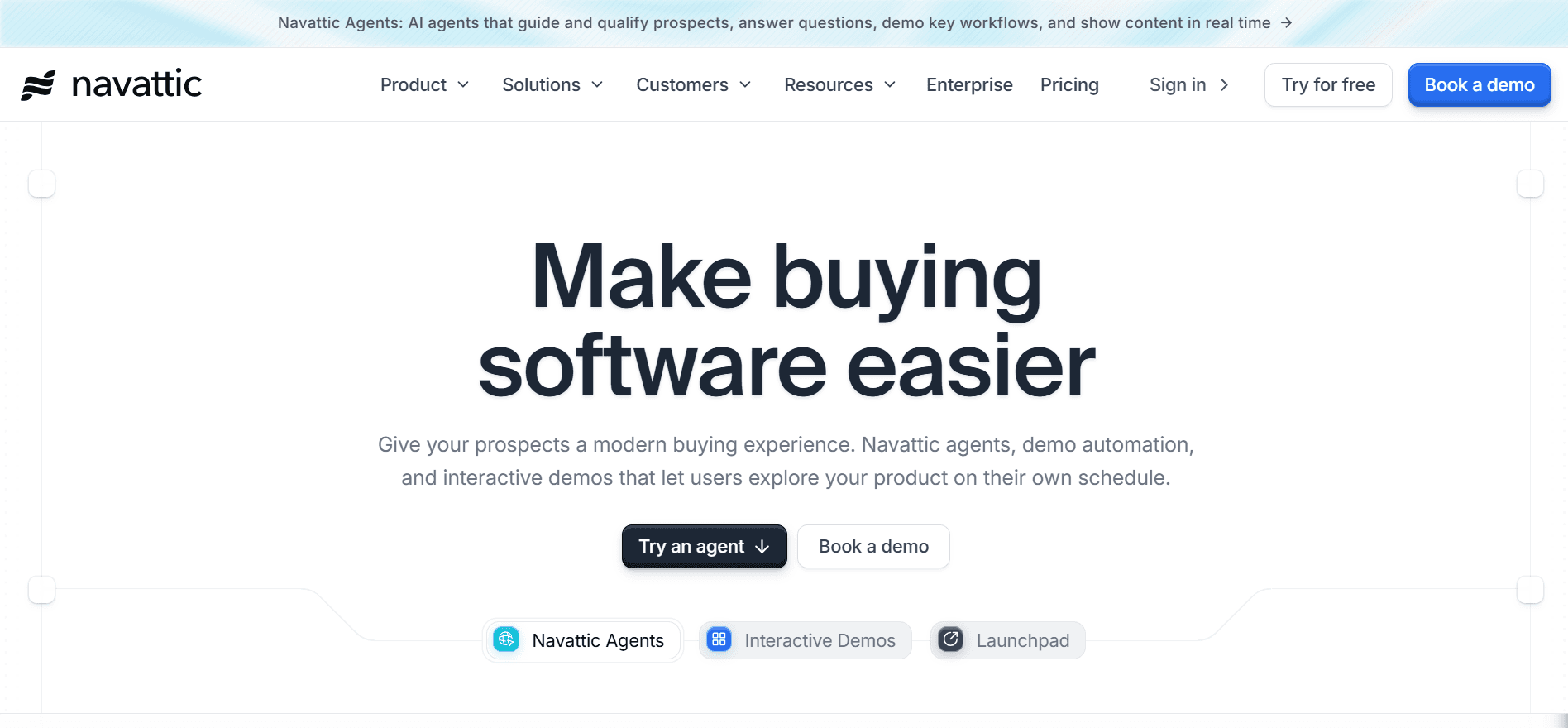
Navattic captures your web app as an interactive HTML clone and turns it into embeddable tours that marketing teams run on product pages, in campaigns, and for ABM.
It's the strongest option on this list for step-level analytics, and in 2026 it added Copilot AI (voiceover, translation into 35 languages) and Agent Demos that answer visitor questions inside a tour.
Key Features
High-Fidelity HTML Capture: Prospects type, scroll, and navigate a clickable clone rather than screenshots. Editing text and data is inline.
Step-Level Analytics and Account Identification: See where each visitor drops off, which companies engaged, and run A/B tests on demo variants (Base plan and up).
CRM and MAP Integrations: HubSpot, Salesforce, and Marketo sync, plus Slack and email alerts when a target account engages.
Pricing
Plan | Price | Notes |
Starter | Free | 1 demo, 1 seat |
Base | $500/month, billed annually | 5 seats, account identification, sandbox demos, A/B testing, dedicated CSM |
Growth | $1,000/month, billed annually | 10 seats, sales integrations, demo translation, SSO |
Enterprise | Custom | Offline demos, audit logs, professional services |
Where Navattic Shines
Analytics depth: Step-level drop-off, account reveal, and A/B testing give marketers the data to improve a tour, not just publish it.
Capture fidelity: The HTML clone feels like the product, which matters for complex interfaces.
Support: 122 G2 reviews single out Navattic's responsive support, the most of any tool on this list relative to review count.
Where Navattic Falls Short
The pricing jump: Startup is capped at one seat and companies of 30 or fewer people; everyone else goes from the free single demo to $500/month.
Qualification stops at engagement: Navattic tells you who clicked. What happens next still depends on a form and a rep.
Customer Reviews
Nick B., a marketer at a mid-market company, wrote on G2 that owning demos in the no-code editor cut turnaround "from weeks to days," and Peyton W., a Head of Marketing, built a first demo in a few hours and, almost three years on, sees inbound demos convert because prospects arrive already knowing the product.
The gripes are about upkeep and packaging. Daniela T., a Product Analyst in financial services, noted on G2 that updating a live demo after a product release "takes longer than it should," that engagement signals don't surface in the CRM as next-step prompts, and that annual fixed-seat pricing is rigid for teams still proving ROI.
Who Navattic Is Best For
Marketing teams embedding tours on the website: Especially PLG and ABM programs that want engagement data by account.
Teams that value analytics over conversation: If you want to optimize a fixed path, Navattic gives you the numbers.
→ Read more: Deciding between the two marketing-led leaders? See Storylane vs. Navattic.
4. Walnut: Best for Sales-Led Personalized Demos on Live Calls
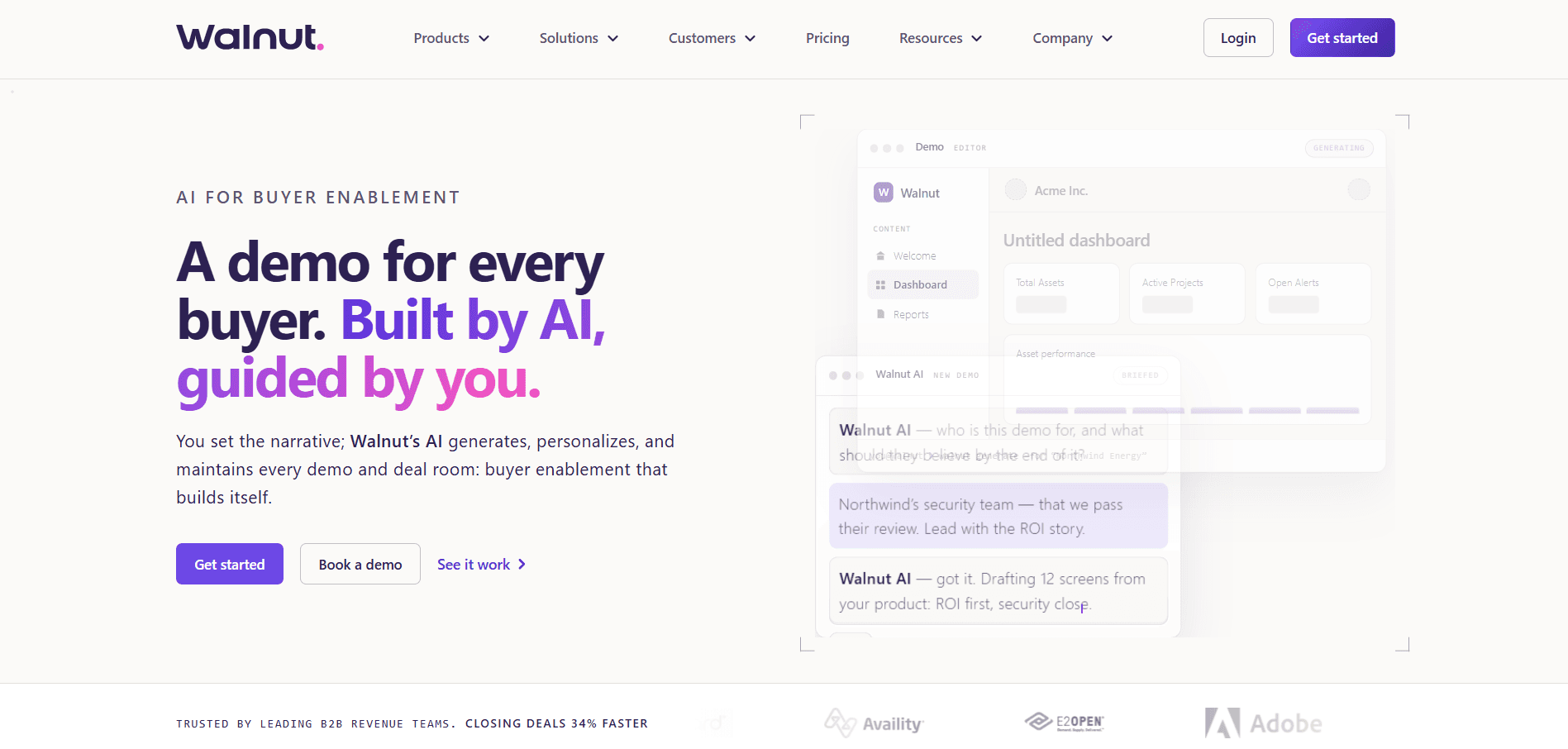
Walnut captures your product's front end and lets reps customize demos per account without engineering: swap logos, data, and flows, then present live or send as a leave-behind. It's built for sales-led teams rather than marketing, with approved templates that keep personalization on-message.
Key Features
Per-Account Personalization: Reps edit text, images, and data fields in the captured environment so a prospect sees their own company in the demo.
AI Demo Engine: AI Mode and StoryCaptureAI draft demo flows and copy, lowering the effort to build a first version.
Templates and Analytics: Sales enablement locks approved templates; reps personalize inside them. Engagement tracking shows what the prospect opened.
Pricing
Plan | Price | Notes |
Ignite | $575/month, billed annually | 3 editor and 3 presenter seats, unlimited demos, CRM integrations; sandbox demos are an add-on |
Accelerate | $1,550/month, billed annually | 6 editor and 6 presenter seats, sandbox demos, prospect personalization, SSO, dedicated CSM |
Scale | Custom | Digital sales rooms, translations, API and MCP access |
Annual contracts only, roughly $6,900 a year at entry. Buyer Xpert, Walnut's AI agent that answers buyer questions inside a demo, is a paid add-on on every tier, metered per conversation. Prices per walnut.io/pricing, September 2026.
Where Walnut Shines
Personalization at the account level: Few tools let a rep tailor a realistic demo this quickly for one prospect.
Guardrails for reps: Approved templates mean personalization doesn't turn into improvisation.
Where Walnut Falls Short
No monthly option and no self-serve trial: You commit to roughly $6,900 before you know if reps adopt it.
The rep still has to build and send: Every personalized demo is rep effort. Buyer Xpert adds in-demo Q&A as a metered add-on, but qualification and routing still run through your reps.
Customer Reviews
Usama S., a COO, wrote on G2 that sales no longer runs "the same demo walk through 20 times a week" because reps swap text and data per prospect instead of rebuilding, and Pushpanjali K., a Solutions Consulting Manager, credits Walnut with ending live-demo breakages and engineering dependency.
Maintenance is the recurring frustration. Jessica H., a Revenue Operations Manager, warned on G2 that every feature release means revisiting demo flows, and when a flow lags the product, prospects see inconsistencies that "can decrease trust." Eline V., a Technical Consultant, added a steeper-than-expected learning curve and the lack of any free trial or monthly plan.
Who Walnut Is Best For
AEs and SEs at mid-market and enterprise SaaS: Teams already running live demos who want each one to feel bespoke.
ABM campaigns: Where a handful of accounts justify hand-built experiences.
5. Consensus: Best for Video-Led Demo Automation Across Buying Committees
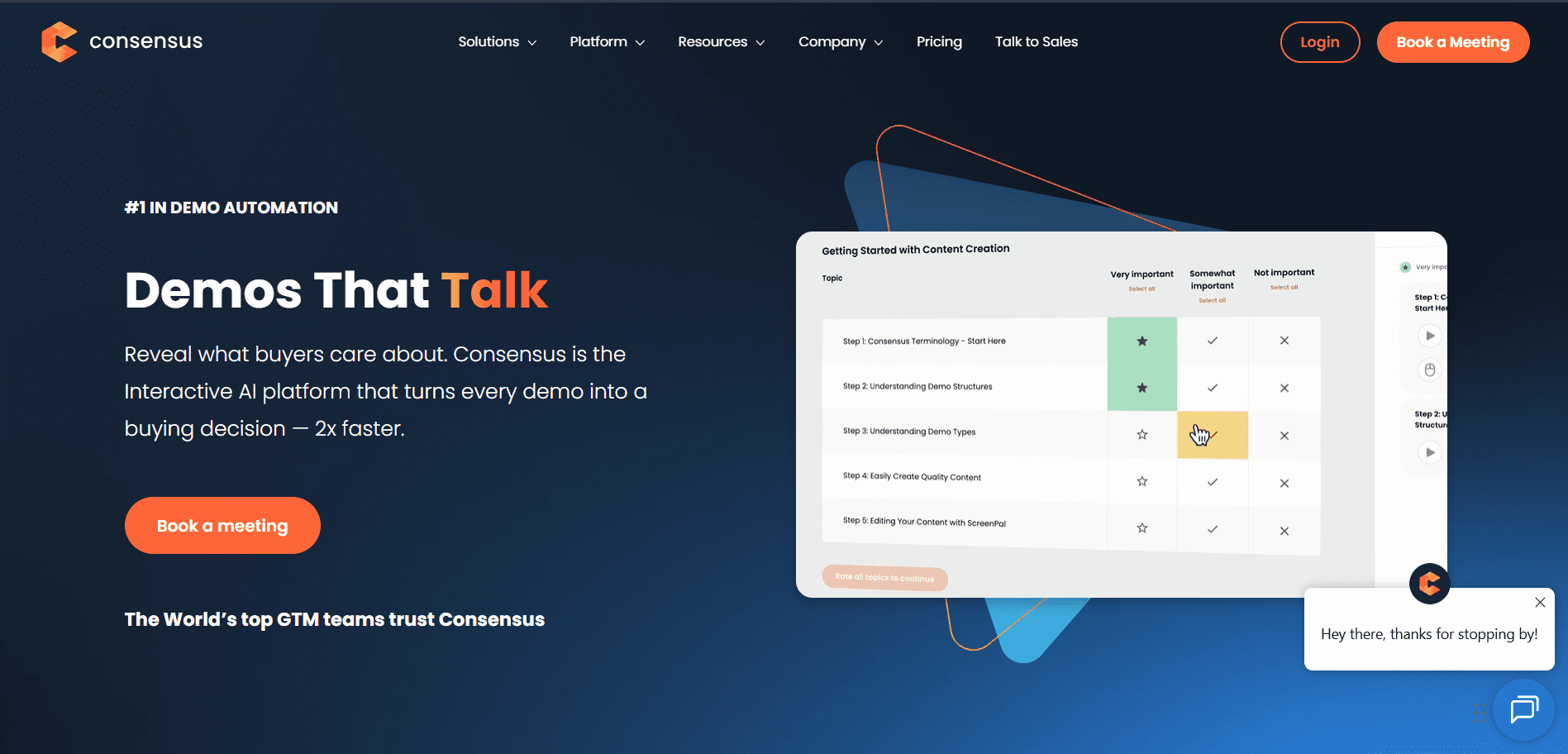
Consensus pioneered demo automation with a library of video demos buyers choose their own path through. Its edge is Demolytics: visibility into every stakeholder who watched, what they cared about, and who they forwarded it to.
In 2026 it added conversational AI Agents and sandbox Simulations. It holds the largest G2 review base in the category, skewed to enterprise.
Key Features
Choose-Your-Own-Path Video Demos: Buyers select the topics they care about; Consensus assembles a personalized video demo.
Demolytics and Stakeholder Discovery: Track viewing by person and surface hidden buying-committee members.
AI Agents and Simulations: Newer conversational agents answer questions, and Simulations give buyers a sandbox to try.
Pricing
Plan | Price | Notes |
All tiers | Not published | Consensus says pricing depends on the products you use and the size of your team |
No free plan or free trial. Every path on the pricing page leads to a sales conversation.
Where Consensus Shines
Buying-committee visibility: No other tool here shows you who forwarded the demo to whom.
Scale for presales: Enterprise SE teams use it to stop re-running the same intro demo hundreds of times.
Where Consensus Falls Short
Video is passive: Buyers watch rather than ask. Questions the video didn't cover still wait for a rep.
Content upkeep: Every meaningful product change means re-recording. Alexandre S., Mid-Market AE, says it's "not a plug-and-play tool" and the value arrives only after an upfront investment in structuring content.
Sales-led buying only: No published pricing and no way to test before an annual commitment.
Customer Reviews
Kaliegh B., an Associate VP of Pre-Sales, wrote on G2 that her solution engineers create videos which AEs and CSMs self-serve without intervention, and Mike B., a VP of Solutions Engineering, says sending videos "helps us sell 24/7/365."
The format itself draws the sharpest criticism. Shana G., an AE, noted on G2 that the biggest drawback is that it's "inherently pre-recorded," so it feels limited when a buyer wants to dig into role-specific workflows or edge cases. Ethan J., a VP of Presales and Enablement, said the UI is confusing enough that he retrains infrequent users.
Who Consensus Is Best For
Enterprise presales organizations: Multi-stakeholder deals where knowing the committee matters more than interactivity.
Teams with a large existing demo video library: Consensus turns it into a self-serve asset.
Consensus coined much of the category vocabulary; here's our take on what demo automation is and where it's heading.
6. Reprise: Best for Enterprise Sandbox Environments Run by Solutions Engineers
Reprise runs three demo formats in one platform: captured click-through tours (Replay), a code-level clone that behaves like your real app (Replicate), and a live overlay that pipes prospect data into your production product on a call (Reveal). Customers include Databricks, MongoDB, and Zendesk. On product realism, it's the closest tool here to Hobbes.
The trade-off is upkeep. Reviewers on G2 flag a steep learning curve and note that maintaining it takes specialized technical skill, and pricing is enterprise-only and unpublished with no self-serve option. It fits enterprise presales teams with complex products and POC-heavy cycles, where a sandbox replaces a costly trial environment. A solutions engineer still has to run it, though. Nothing on the page engages a visitor on its own.
For a plain-English breakdown of Replay, Replicate, and Reveal-style formats, read our guide to interactive demos.
7. Demostack: Best for Consistent, Realistic Demo Environments Across Large Sales Orgs
Demostack clones your entire product front end so every rep demos from the same stable environment, with no broken staging servers and no live-data risk. Layer persona, industry, or account variants on one master clone, and hand buyers a guided version after the call. David G., a VP of Solutions Consulting, wrote on G2 that it cut custom demo turnaround from a three-day wait to under 24 hours.
Upkeep is the recurring cost. The clone captures a moment in time, so a meaningful product update means rebuilding it, and G2 lists a three-month average time to implement. Pricing is enterprise-only and unpublished, with no free trial. It suits large sales orgs standardizing the live demo across dozens of reps, especially products with fragile staging where a failed demo costs the deal. Like the other sandbox tools here, it still needs a rep to run the demo.
8. Arcade: Best for Fast, Polished Demos for PLG and Product Marketin

Arcade records your screen and turns one capture into a clickable demo, a narrated product video, and social assets. It leads the category on speed and visual polish, and its free tier is one of the most usable around. Lior K., a CTO at a real estate software company, wrote on G2 that interactive demos replaced screenshots and long videos on his marketing site, and the impact was immediate.
True HTML cloning is Enterprise-only, where Navattic and Storylane offer it at lower tiers, and reviewers call the jump between plans steep for smaller teams. Paid plans start at $42.50 per seat a month billed annually (per arcade.software/pricing, September 2026). Arcade does a different job from complex-product demos. It fits product marketing and PLG teams, and simple products where a two-minute walkthrough answers most questions. It shows a simple product well, then hands the visitor back to your form.
9. Supademo: Best Low-Cost Entry Point for Small Teams

Supademo is the most accessible tool on this list. Paste a URL and its AI drafts a walkthrough; install the Chrome extension and you're capturing in seconds. It's strong at fast, low-cost demo creation for onboarding, help centers, and product tours, and it has been adding AI and conversational features, including a usage-based AI Demo Agent add-on. Lula A., a Product Marketing Manager, wrote on G2 that pricing beat other enterprise-grade tools and demos went live in minutes with no developer.
The paid entry point is the lowest in the category, starting at $38 per creator a month billed annually (per supademo.com/pricing, September 2026), though HTML cloning and sandbox demos sit on the $350-a-month Growth tier and analytics run lighter than Navattic's or Storylane's. It fits small teams that want polished walkthroughs fast, plus documentation and onboarding teams where demos double as help content. The real question is product complexity. If your product needs a conversation to land, this is the wrong fit.
One thing none of the nine tour builders above solves: the visitor who arrives after hours. That's why your website is losing deals at midnight.
How to Choose the Right Sales Demo Platform
Start with the job, not the feature list. The five demo formats below solve different problems, and most teams need one, sometimes two.
Format | Who drives | Answers unscripted questions | Qualifies the buyer | Examples |
Live rep demo | Rep | Yes | Yes, manually | Your AEs |
Video demo | Vendor | No | No | Consensus |
Click-through tour | Vendor-built path | No | Form only | Storylane, Navattic, Arcade, Supademo |
Sandbox environment | Buyer, rep-assisted | Partly | No | Reprise, Demostack, Walnut |
AI-led conversational demo (agent-led growth) | Buyer | Yes | Yes, automatically | Hobbes |
Does the Buyer Drive, or Follow a Path?
Rep-free does not mean question-free. A tour answers the questions you predicted; a conversation answers the buyer's own question. Rep-free early does not mean rep-free forever, either. The same buyers bring in a rep later to validate what they found before they commit.
The case for a tour is real: it's cheap, it ships in an afternoon, and it never misstates your product. The objection to an agent is the mirror image, that it might. Hobbes answers that two ways: it runs simulations against real buyer scenarios before launch, and in production it flags what it can't answer instead of guessing.
So the buyer can ask anything, and Hobbes shows the relevant product screen alongside the answer.
What Happens After Engagement?
Most demo tools stop at "someone clicked." You still need a form, a scoring model, and a rep to follow up. Ask any vendor: does the tool enrich the contact, score against my ICP, and book the meeting?
Hobbes does all three and pushes the full conversation into your CRM, so reps only meet real buyers. We cover the mechanics in AI lead qualification for sales teams.
Who Maintains It When the Product Changes?
Captured tours, video libraries, and clones go stale on every release. Budget the rep or marketer hours to rebuild them, or pick a tool that reads your docs and help center as they change. That's one of the four self-improving behaviors Hobbes runs by default.
Going the captured-tour route? Our guide covers how to keep one current.
Does It Cover Off-Hours and Other Languages?
If a third of your traffic arrives outside business hours or from outside your home market, a demo that waits for a rep is a demo that never happens. Look for native localization with regional terminology, not machine translation.
Hobbes runs the demo and the conversation in the buyer's language, 24/7, and Hobbes Links extend the same demo to outbound sequences and follow-ups.
What Is the Total Cost, Including Seats and Rep Time?
Sticker price is rarely the full number. Seat minimums, HTML capture gates, and separate AI agent lines add up, and a tool that still needs a rep on every call keeps costing rep hours.
Hobbes pricing is quote-based, but implementation and optimization are included and no rep is in the loop until the buyer is qualified. For a wider pricing survey, our roundup of the best product demo software covers 12 platforms.
Run the Same 30-Minute Test on Every Shortlist
Vendor claims converge; buyer experiences don't. Before any sales call, do this:
Pull the five questions your reps hear most on first calls. Pricing, a specific integration, a security requirement, a "can it do X" edge case, and a competitor comparison is a typical set.
Put all five to each vendor's own public demo, the way a visitor would. Count how many get a usable answer with no human involved. Most tours will answer one or two; Hobbes demoing itself is a fair place to start.
Then check what exists afterward. Did anything land in a CRM record, and would a rep know what you asked? That's the difference between engagement and qualification.
How We Selected These Sales Demo Tools
Nine tools made this list out of roughly twenty we looked at. Here's the method, so you can weigh the ranking against your own priorities.
Started from the SERP: We pulled the tools ranking for "sales demo software" and related terms in September 2026, then checked each vendor's current site, pricing page, and G2 or Capterra profile.
Ranked by the size of the problem, not feature count: Every entry is "best for" something concrete. The demo request form leaks more pipeline than any rep workflow, which is why Hobbes sits first and Storylane, the strongest demo builder, second.
Scored each tool on the five questions above: Does the buyer drive, what happens after engagement, who maintains it, does it cover off-hours and languages, and what it costs in seats plus rep time.
Read at least one critical G2 review per tool: Every entry quotes a named reviewer on where the product falls short.
Disclosed our bias and credited the competition: Hobbes is our product, so we listed who it's wrong for, and we said where rivals are stronger: Storylane on creation speed, Navattic on analytics, Consensus on committee visibility, Reprise and Demostack on enterprise realism, Arcade and Supademo on cost.
Whichever you pick, the tool matters less than the motion around it, which is why we also wrote up how to increase demo conversion rates.
Final Word on Hobbes
Reps building and sending demos should buy Storylane, Navattic, or Walnut. Everyone else is losing the 98% who never fill out the form, and no copy tweak fixes that. That's the case for agent-led growth: Hobbes runs the first demo for every visitor and hands reps qualified buyers with the full conversation attached. Watch Hobbes demo itself, no form or calendar link required.
Frequently Asked Questions
What Should I Look for in Sales Demo Software in 2026?
It depends on your motion. Marketing-led teams should prioritize creation speed, embed options, and step-level analytics. Sales-led teams should prioritize per-account personalization and CRM sync.
Teams whose bottleneck is website conversion should prioritize a buyer-driven conversation, ICP qualification, and routing, which is what an AI Sales Employee like Hobbes adds. That third job is new, and it's changing how B2B sales works.
Which Sales Demo Tools Are Commonly Compared?
Storylane, Navattic, Walnut, Arcade, and Supademo are the interactive demo builders most often compared. Consensus, Reprise, and Demostack come up in enterprise presales evaluations.
Hobbes is compared against all of them but sits in a different category, agent-led growth: a conversational agent that demos a sandbox replica and qualifies the buyer. If that category is new to you, start with what an AI demo agent is.
Does Sales Demo Software Replace Sales Reps?
No. Tour builders make reps faster. Hobbes replaces the demo request form and the first qualification call, then routes qualified buyers to a rep with full context. Gartner's May 2026 survey found 69% of buyers still turn to a rep to validate AI-generated insights.
The rep's job moves later in the cycle; it does not disappear. Our guide to demo automation covers what to automate and what to keep human.
How Much Does Sales Demo Software Cost?
Sometimes nothing to start. Storylane, Navattic, Arcade, and Supademo offer free tiers. Published paid plans run from $38 per creator a month (Supademo) to $1,550 a month (Walnut Accelerate); Storylane and Navattic sit between at $40 to $1,200 a month.
Consensus, Reprise, and Demostack don't publish pricing. Hobbes is quote-based with managed implementation included; contact sales.
Get a Demo
Ready to See Hobbes in Action?
Watch Hobbes run a live demo on itself. No forms, no scheduling, no rep required.
Start Demo
Experience a Demo
Ready to see Hobbes in Action?
Designed for teams who need control, consistency, and measurable impact across every demo touchpoint.