Chirag Kulkarni
Co-Founder, Hobbes
Chirag Kulkarni is the co-founder and CEO of Hobbes, an AI company building autonomous, conversational product demos for B2B software companies. Before Hobbes, he worked at McKinsey, built AI tools for the Pentagon, and held strategy and operations roles at high-growth startups.
Key takeaways
Hobbes is best for B2B SaaS teams whose buyers want to click through the product and ask questions before a rep ever joins.
Reprise is best for enterprise presales teams whose demos fall apart without realistic data.
Walnut is best for reps sending a tailored demo into an active deal.
Storylane and Navattic are best for marketing teams that want a demo on the website this week. Both have free plans.
Demostack and Demoboost are best for presales teams that want a full demo environment rather than a demo asset.
Consensus spent 2026 rebuilding itself, with two acquisitions and a relaunch on October 14. Teams weighing Consensus alternatives through all of that still want the same question settled, which is who runs the demo when a buyer shows up ready to see the product.
Hobbes runs it the moment they arrive. Every visitor meets an interactive sandbox of your product, asks whatever they want by text or voice, and gets scored against your ICP and routed to the right rep, 24/7 in 30+ languages.
The shortlist also runs Reprise, Walnut, Storylane, Navattic, Demostack, and Demoboost, from cloned presales environments to fast website demos.
Top 7 Consensus Alternatives Compared
Presales teams get an environment to demo from. Marketing and sales get demos to build and send. Hobbes runs the demo itself.
Tool | Best for | Demo format | Stand-out feature | Starting price |
Hobbes | Demos your buyers run themselves | AI product agent on an interactive sandbox of your product | Buyer-led conversation with ICP scoring and CRM routing | Contact sales |
Reprise | Demos that depend on real data | App clones, guided demos, AI data injection | Unlimited data injection in cloned or live environments | Contact sales |
Walnut | AI-personalized sales demos and deal rooms | Captured interactive demos, playlists, sandbox demos | AI Mode drafts a tailored demo per buyer | $575/month, billed annually |
Storylane | Shipping your first demo fast | Screenshot, video, HTML capture, sandbox on Enterprise | Published tiers from a free plan upward | Free; paid from 50/month(40 billed yearly) |
Navattic | Turning website traffic into leads | HTML capture tours, sandbox demos, agents | Account identification and A/B testing | Free; paid tiers contact sales |
Demostack | Teams that build their own demo environment | Cloned demo environments | A branded clone your team controls end to end | Contact sales |
Demoboost | Overlay demos on your live product | HTML, screenshot, video, mobile, sandbox, overlay | Overlay demos that run on your live product | $375/month, billed yearly |
Before you shortlist anything, Talk to Hobbes and ask it the questions your buyers ask you. Every answer arrives with the product on screen. No form, no calendar link.
How We Evaluated the Consensus Alternatives in This List
We shortlisted the platforms Consensus buyers already compare against, using Gartner Peer Insights and G2's Demo Automation category, then read every vendor's current site, pricing page, and reviews, critical ones included. Hobbes is our own product, so its entry names who it's wrong for too.
We scored each platform on five things:
Who drives the demo: a prepared asset, a rep on a call, or the buyer's own questions.
What happens after engagement: whether the platform enriches, scores, and routes the buyer, or stops at a view count.
Format fit: video, interactive tour, cloned environment, overlay on your live product, or conversation.
Upkeep after a release: who rebuilds the demo when your UI changes, and how long that takes.
Total cost: seats, feature gates, add-ons, and presales hours, rather than the sticker price alone.
Consensus leads on format breadth, connecting self-guided tours, AI conversations, live demos with real-time data injection, and Demo Intelligence into one journey, and it relaunched around that strategy at DemoFest London on October 14, 2026. That breadth is why teams stay for committee deals. Weigh it against a platform assembled fast, with Peel announced in April 2026 and Saleo closed in June, and a form-gated pricing page with no free plan.
The alternatives below answer those questions differently, starting with the one that changes who runs the demo altogether.
1. Hobbes: Best for Demos Your Buyers Run Themselves

Your best demo shouldn't depend on which rep is free. Hobbes meets every website visitor with an interactive sandbox of your product, answers whatever they ask, scores them against your ICP, and books the meeting, around the clock.
Consensus splits this work across specialized agents, with an AI Demo Agent for autonomous demos and a Marketing Agent for qualification, plus separate agents for rep-led live demos and post-sale enablement. Hobbes runs one agent instead, handling the demo, the questions, and the qualification in a single conversation on an interactive sandbox of your product:
The buyer drives the conversation. They ask, Hobbes answers, and the relevant part of your product appears on screen.
The buyer explores an interactive sandbox of your product. They click through the software themselves, or take the controls from the agent partway through.
Qualification and routing happen in the same conversation. The buyer gets scored and routed without a form in between.
Hobbes covers the demos your team never gets to run. The visitor at 2 a.m. The evaluator in another time zone. The analyst who wants to click around before talking to anyone.
Hobbes Key Features
Hobbes runs on your website for inbound demand and through Hobbes Links, personalized demo links for outbound campaigns and follow-ups.
#1. An Interactive Sandbox of Your Product so That Buyers Click Through It Themselves

Point Hobbes at your product and the first sandbox can be standing inside an hour. No engineering ticket.
Hobbes builds it from live product capture plus your docs, help center, sales decks, and recorded sales calls, so the agent knows the answers your best SE gives. The captures update themselves when your UI shifts next sprint. The buyer or the agent can take each demo down a tailored path, so a RevOps lead and a CFO walk away having seen two different products.
#2. Adaptive Conversations so That Every Buyer Gets Their Own Demo

Buyers ask anything, by text or voice, and Hobbes answers with the matching product view on screen.
While Hobbes walks a buyer through the demo, it's quietly doing the homework a rep usually only gets to on the first call, researching the visitor's company in real time, surfacing the use cases built for their role, and adapting the demo as the questions change. It runs in 30+ languages, translating the conversation and your product interface into the terminology that region actually uses. No lead waits overnight.
Meanwhile, conversational intelligence logs every transcript, product heatmap, and objection, so your team sees which features buyers push on and where they stall.
#3. Qualification and Routing so That Reps Only Meet Real Buyers
By the time a rep joins the deal, Hobbes has already done the first call's work:
Enrichment: LinkedIn, phone, and company data attached to the contact.
ICP scoring: Scored against the criteria you set, rather than a generic lead score.
Next step: A calendar or checkout offered the moment intent is clear.
Routing: The right rep, with the full conversation already in HubSpot, Salesforce, Attio, or Pipedrive.
For lower-ACV deals, Hobbes can run the deal from discovery to close, handing off to a rep where that makes sense. After the sale, the same agent onboards new users in a sandbox and shows existing customers what else your product does when they engage.
Hobbes Pricing
Plan | Price | What's included |
Starter | Contact sales | Conversational agent and sandbox, core analytics, native CRM integration (HubSpot, Attio, Salesforce, Pipedrive), webhooks, dedicated Slack channel |
Growth | Contact sales | Everything in Starter, plus qualification scoring, objection tracking, people enrichment, a named implementation manager, API and MCP support |
Scale | Contact sales | Everything in Growth, plus whitelabeling, agent-driven product refresh, a named customer success manager, priority support, GitHub sync |
Custom | Contact sales | Everything in Scale, plus SSO/SAML, security review, custom DPA, data residency, SLA, a dedicated solutions engineer |
All four tiers are quote-based. Compare what each one includes on the Hobbes pricing page.
Where Hobbes Shines
An interactive sandbox of your product, standing fast: The first sandbox can be ready within an hour with no engineering, and the captures update themselves.
A fully dynamic product experience: The buyer or the agent walks the product down a tailored path, so no two demos run the same way.
A self-improving agent: Hobbes runs simulations against real buyer scenarios before launch, flags what it can't answer instead of guessing, re-reads your docs and help center as they change, remembers returning visitors, and sharpens with every conversation.
Qualification that reaches your reps: Reps open the record with the score and the full conversation already in it.
24/7 coverage in 30+ languages: Hobbes translates both the conversation and your product interface into the buyer's language.
Managed implementation: You go live in days, with simulations, evaluations, and ongoing optimization included.
Where Hobbes Falls Short
Overkill for simple products and quick launch tours: Teams whose buyers understand the product in 30 seconds, or who want a short click-through for a launch page, will get there faster with Storylane or Navattic.
It needs your input to stay accurate: Hobbes needs product access, source materials, and an owner on your side to review and approve what the agent says. Teams hoping to switch on an unreviewed agent and walk away aren't a fit.
Hobbes Customer Reviews
Customers describe the same change. More real buyers reach a rep, and they arrive already educated.
Take Sutton. Their website pulled traffic, but the demo request form was the only way in. After Hobbes, CRO Simon Kronenberg watched human bookings jump 53%.

In his words, "Hobbes has seriously increased the number of qualified leads from our website." Read the full Sutton story.
SalonScale had the same problem on a different clock. Its buyers run salons all day and research software at night, so 64% of its Hobbes demos happened outside business hours, and more than 10% of Hobbes-engaged prospects converted to sign-up.

Whitney Hight, who runs sales at SalonScale, said, "Hobbes provides a way for customers to check out our system on their own time, which is invaluable."
Who Hobbes Is Best For
Marketing leaders who own website conversion: CMOs, VPs of Marketing, and Heads of Growth or Demand Gen who want anonymous traffic to turn into qualified pipeline.
Sales leaders running a demo-heavy motion: CROs, RevOps leads, and SE managers who want reps to meet only real buyers and to reclaim the hours spent on repetitive first demos.
Mid-market B2B SaaS with complex products: Roughly 51 to 5,000 employees, $5K+ ACV, and several buyer personas to serve at once.
Teams leaving Consensus for a two-way demo: Anyone whose buyers reply to a polished demo with questions nobody was there to answer.
Hobbes trains a proof-of-concept agent on your own product before you commit to anything, so you can pressure test it against your hardest demo. See your Agent running on your product.
2. Reprise: Best for Demos That Depend on Real Data

Reprise clones your application into a resettable sandbox, layers no-code guided demos on top, and injects tailored data into cloned or live environments. It shipped its Agentic Demo Builder in August 2025 and an MCP server carrying more than 100 demo-authoring tools in June 2026.
Key Features
Full application cloning: Resettable sandbox copies of your app, with no exposure to production.
Unlimited AI data injection: Populate demos with buyer-appropriate data instead of editing records by hand.
Enterprise security in every package: SOC 2 Type II and ISO 27001, with SSO and RBAC included rather than sold as add-ons.
Pricing
Reprise publishes no figures. Its pricing page describes a single annual platform fee plus per-user licenses, quoted on request, with the security and access controls above in every package. Confirm current numbers with Reprise.
Where Reprise Shines
Complex enterprise apps: Clones and data injection reproduce edge-case paths that capture alone misses.
Governance: ISO 27001, RBAC, and dedicated CDN delivery, included in every package.
Support: Responsiveness is the most-mentioned strength in its G2 reviews.
Where Reprise Falls Short
Build time: Complex demos take substantial time to build, and that time comes out of your SE team's week.
Learning curve: Non-technical users flag a steep start, and an editor where preview and edit views don't always agree.
Customer Reviews
Reprise holds 4.4/5 from 175 reviews on G2, where reviewers credit it with building customized demos without engineering help. The recurring complaint is the clock. One mid-market reviewer wrote, "The time commitment associated with building a reprise tour is pretty substantial." Both points repeat across the profile, strong output on complex applications and the SE hours needed to get there.
Who Reprise Is Best For
Enterprise presales and SE teams: Teams whose demos live or die on the data showing on screen.
Security-heavy buyers: Companies that need ISO 27001 and strict access controls on demo environments.
For a wider view of clone and capture tools, read our guide to the best product tour software.
3. Walnut: Best for AI-Personalized Sales Demos and Deal Rooms

Walnut captures your product once, then its AI Mode drafts demos and playlists per buyer from that capture, with every screen approved before a buyer sees it. Deal rooms hold the demos, documents, and mutual action plans in one shared space.
Key Features
AI Mode for demos and playlists: Describe the demo you need and Walnut drafts the screens, flow, and narrative.
Deal rooms and hub playlists: Bundle demos and documents into one guided path per buyer, and track every stakeholder.
Buyer Xpert: An AI agent inside the demo that answers questions from your approved content, sold as a metered add-on.
Pricing
Plan | Price | Seats and credits |
Ignite | $575/month, billed annually | 3 editors, 3 presenters, 50,000 AI credits |
Accelerate | $1,550/month, billed annually | 6 editors, 6 presenters, 100,000 AI credits |
Scale | Contact sales | Custom seats, 200,000 AI credits |
Every plan runs on an annual credit pool with no overage charges, and top-up packs start at $1,000 for 50,000 credits. Sandbox demos, SSO, and white labeling are add-ons on the lower tiers. Confirm the current structure with Walnut.
Where Walnut Shines
Personalization at speed: Reps tailor a demo per prospect without rebuilding it from scratch.
Deal context: Deal rooms and stakeholder tracking tie demo activity to the opportunity record.
Reach: Translations cover up to 243 languages, with Salesforce, HubSpot, Marketo, and Slack integrations.
Where Walnut Falls Short
Demo upkeep: Maintaining demo flows is the most common complaint tag on its G2 profile.
Add-on math: Sandbox demos, sales rooms, SSO, and Buyer Xpert sit outside the base plans, so real cost depends on which you need.
Customer Reviews
Walnut holds 4.5/5 from about 150 reviews on G2. Reviewers keep returning to per-prospect flexibility, as one small-business COO wrote, "I can set up the demo differently for all my prospects and not have to remake the whole thing." The criticism is just as consistent on maintenance, with a sales ops manager writing, "The part that I do not like about Walnut is maintenance of demos." Its reviews split the same way, with reps liking the output and whoever owns the library carrying the cost.
Who Walnut Is Best For
Mid-market and enterprise sales teams: Reps who send a tailored demo into a live deal.
Teams running deal rooms: Sellers who want demos, documents, and action plans in one place for a committee.
4. Storylane: Best for Shipping Your First Demo Fast

Storylane publishes its full pricing table and offers a free plan covering one seat and one published demo. Ease of use is its most-mentioned strength on G2. Its formats run past tours, with HTML capture on Growth, sandbox demos on Enterprise, and RepX, a separately priced line of AI SDR agents.
Key Features
Demo formats that grow with the team: Screenshot, video, HTML capture, Figma-to-demo, and Enterprise sandboxes.
Hubs and personalization: Persona-based demo hubs, personalization tokens, and A/B testing.
RepX agents: AI SDRs that run discovery, handle objections, and convert inbound visitors into meetings, sold as a separate line.
Pricing
Plan | Monthly | Billed yearly | Notes |
Free | $0 | $0 | 1 seat, 1 published demo at a time |
Starter | $50/month | $40/month | 1 seat; extra seats $40 |
Growth | $625/month | $500/month | 5 seats, HTML demos; extra seats $100 |
Premium | $1,500/month | $1,200/month | 10 seats, HTML demos, hubs |
Enterprise | Contact sales | Contact sales | Adds sandbox demos |
RepX is priced separately, starting at $2,000/month. Confirm current figures with Storylane.
Where Storylane Shines
Self-serve start: The free and Starter tiers both sign up without a sales call.
Format range: Teams can start on screenshot tours and move into HTML and sandbox demos later.
Review depth: The largest review base in this comparison, across both marketing and presales use cases.
Where Storylane Falls Short
Plan gating: HTML demos start on Growth and sandboxes on Enterprise, and the step up from Starter is a big one.
Managing demos at scale: Demo management and customization limits are the top complaint tags on G2, and reviewers flag mobile demos as a weak spot.
Customer Reviews
Storylane holds 4.7/5 from more than 1,600 reviews on G2, the deepest review base among these Consensus alternatives. The positive reviews repeat the same point. One mid-market reviewer wrote, "I love how easy is to use the tool, and how the demos end up looking amazing." The pushback is about what each plan includes. As a verified mid-market user put it, "In our plan I can't invite team members to actively edit/view existing demos and analytics." Across the profile, setup speed and plan limits are the two themes.
Who Storylane Is Best For
Startups and small teams: Groups that need a published demo this week and can grow into the paid tiers.
PMM and marketing teams: People building demos for launch pages, emails, and campaigns.
Weighing it against the rest of the field? Read our breakdown of the best Storylane alternatives.
5. Navattic: Best for Turning Website Traffic Into Leads

Navattic is a no-code platform built on HTML capture, aimed at marketing teams. Its analytics cover account identification, A/B testing, and pipeline reporting, which tie a demo view to an opportunity. In March 2026 it added Navattic Agents, where a prospect asks a question in plain language and an agent navigates a live demo account or Navattic sandbox to answer it.
Key Features
HTML capture tours: Interactive demos that embed on your site, with sandbox demos on higher tiers.
Funnel analytics: Step-level drop-off, account identification, A/B testing, and pipeline reporting.
Navattic Agents: Guide and qualify prospects, answer questions, and demo workflows in real time, priced by conversations and agents.
Pricing
Navattic publishes only its free Starter tier, which covers one seat and one demo. Base and Growth show annual billing with no figure attached, Enterprise is custom, and a Startup plan serves bootstrapped and seed-stage teams of 30 or fewer. Third-party roundups still quote a $500/month Base price that no longer appears on the page, so request a quote through Navattic's pricing page rather than trusting a published figure.
Where Navattic Shines
Step-level analytics: Drop-off reporting per demo step, broken out by account.
Integration breadth: Salesforce, Marketo, Gong, Salesloft, Outreach, Seismic, and Highspot.
Where Navattic Falls Short
Recapture work: Captures are copies of your interface, so shipping UI changes means recapturing.
Agents are new and priced apart: Navattic Agents launched in March 2026, and only the free tier carries a published number.
Customer Reviews
Navattic holds 4.8/5 from 1,115 reviews on G2, and reviewers point to how little technical help a demo needs. "It's so simple to use and requires zero code," wrote one mid-market reviewer. What they flag instead is navigation inside the builder, and an SE manager wrote, "I believe there are too many buttons and pathways to achieve your objective as a user." A Navattic customer on r/salesengineers backs that up, describing how they score outbound prospects by how many steps of a tour each one completes.
Who Navattic Is Best For
Product marketing and growth teams: Teams running top-of-funnel demos on the website and in campaigns.
Data-driven marketers: Anyone who wants account-level demo analytics tied to pipeline.
New to the format? Our explainer on what an interactive demo is covers the basics.
6. Demostack: Best for Teams That Build Their Own Demo Environment
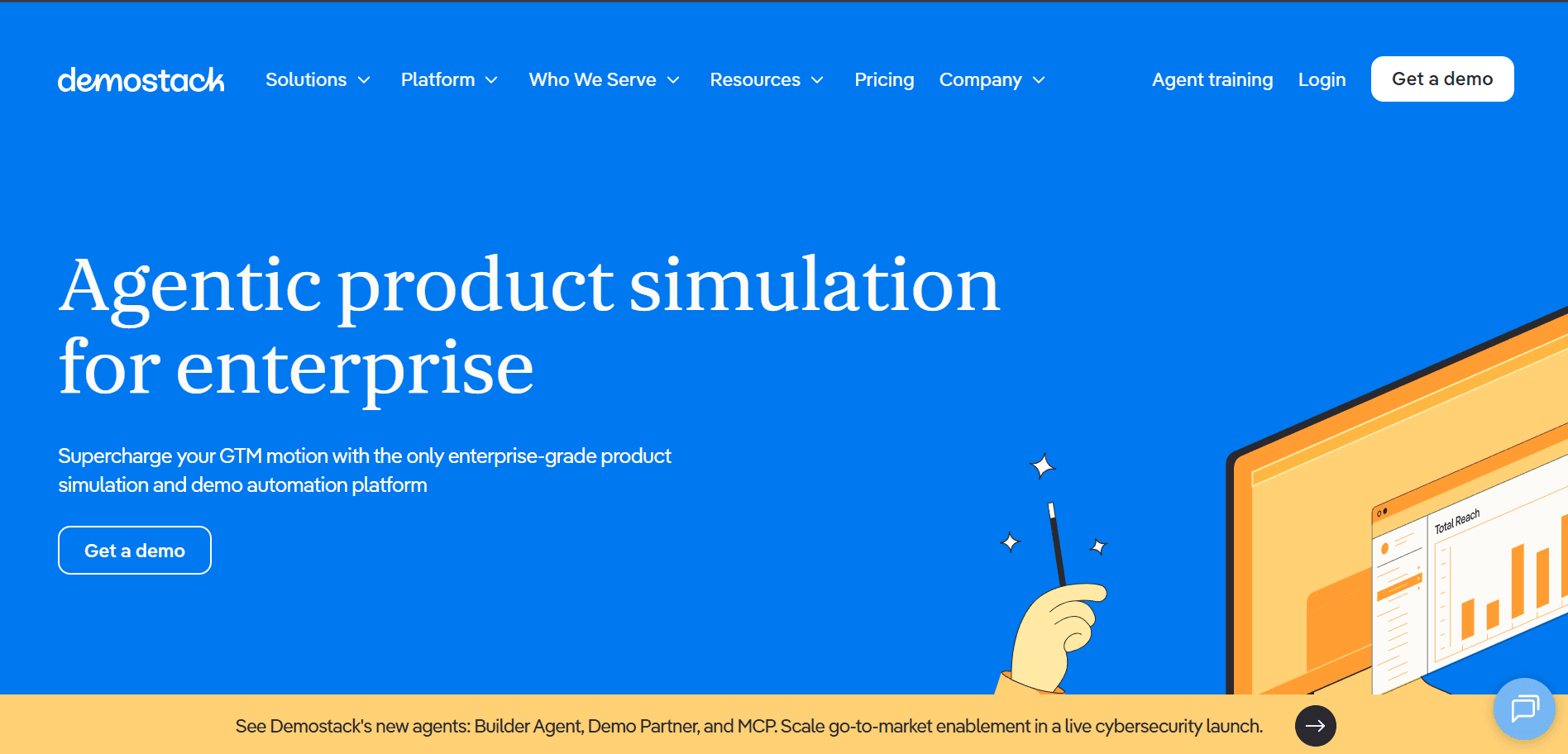
Demostack gives presales teams a fully cloned demo environment they control, where they can edit the data, rebrand the interface per prospect, and demo without touching production. Its June 2026 release of Builder Agent and Demo Partner brought agentic AI into both building and presenting.
Demostack publishes no pricing, and its own FAQ takes on the question of why it costs more than other options. Vendr's buyer data puts the median contract at $32,960 per year. It holds 4.7/5 on G2, where the most common complaint is upkeep. One account executive wrote that product changes "necessitate recreating all existing clones from scratch." Demostack suits enterprise presales teams with the SE capacity to keep a cloned environment current, and our Demostack alternatives breakdown goes deeper on what moving off it involves.
7. Demoboost: Best for Overlay Demos on Your Live Product

Demoboost covers interactive tours, video, mobile demos, sandboxes, and overlay demos that run on top of your live product. It publishes prices on three of its four plans.
Plans start at $375/month billed yearly for Start Up, with Essentials at $600, Growth at $1,200, and Enterprise quoted. Sandbox demos arrive on Growth, overlay demos are Enterprise-only, and there's no self-serve free trial. Demoboost holds 4.8/5 from 122 reviews on G2, where reviewers single out fast demo creation and support response times. It fits mid-market presales teams that want a demo environment with a published starting point.
Reasons to Consider an Alternative to Consensus
Teams leave a platform this well reviewed for reasons that have little to do with quality. Before you renew, ask which parts of Peel and Saleo are live in the product you'd actually be buying.
Demo Creation Costs Your Team Clicks. G2 tracks this one. Its Consensus pros and cons page reports too many clicks in demo creation across 171 separate mentions, a cost that lands on the presales team you bought the platform to protect. Hobbes stands up your first sandbox within an hour, with no engineering.
The Buyer-Led Layer Is the Newest Part of the Platform. Consensus's AI Demo Agent runs autonomous demos buyers drive themselves. Peel was announced in April 2026, Saleo closed in June, and Consensus relaunched on October 14, so the video and tour products carry years of reviews while the agent layer has months. Hobbes has run on one engine since launch.
Pricing Is Quote-Only and Scales With Seats. Consensus's pricing page describes per-user licenses plus usage-based capabilities, behind a form, and the $600/month figure quoted around the web sits in that page's meta description rather than on the page. Every rep you add is another license, which is how demo automation stays locked to presales. Hobbes is quote-based too, but priced around the agent rather than the reps who log in.
Scoring for Fit Is Still Your Team's Job. Consensus qualifies, with a Marketing Agent that captures intent and Demo Intelligence that shows who sits in the buying group. Whether that account resembles the customers you actually close is a separate measurement, and it's the one Hobbes makes, scoring each buyer against the ICP criteria you set before the transcript reaches your CRM. Reps only meet real buyers.
More on what to measure in our personalized demos and conversion rates breakdown.
Pick the Alternative That Matches Who Runs Your Demo
Every platform here builds a good demo, so choose by who drives it. Presales teams demoing on real data should look at Reprise, Demostack, or Demoboost. Reps sending tailored demos into live deals want Walnut. Marketing teams converting website traffic want Storylane or Navattic.
Teams that want every buyer to explore the product and reach a rep already qualified should start with Hobbes. Talk to Hobbes and see what your buyers would get.
FAQs
1. Which Consensus Alternatives Run the Demo as a Conversation?
Hobbes, which runs the whole demo as a buyer-led conversation on an interactive sandbox of your product. Walnut's Buyer Xpert, Navattic Agents, and Storylane's RepX also answer questions inside a demo, each priced separately from the base plan. Consensus ships its own AI Demo Agent, so the question is depth rather than availability.
2. What Happened to Saleo and Peel After the Consensus Acquisitions?
Both became part of the Consensus platform in June 2026, and Consensus relaunched around them on October 14. Saleo brought live demos with data injected into your native product, and Peel brought conversational AI for buyer engagement signals. Neither is an independent alternative now.
3. Which Consensus Alternatives Publish Their Pricing?
Three of them. Storylane, Walnut, and Demoboost list figures on their pricing pages, Navattic publishes only its free tier, and Hobbes, Reprise, and Demostack are quote-only.
4. How Long Does Replacing Consensus Usually Take?
Expect weeks for a like-for-like swap. You'll recapture or rebuild your demo library, so ask each vendor for a build estimate on your hardest flow. Managed implementations shorten it. Sutton launched its Hobbes agent in under 14 days.
5. Do AI Demo Agents Work for Complex Enterprise Products?
Yes, when the agent demos the product itself rather than a script. Complex products are where prepared demos break, because buyers ask about edge cases. Run your hardest workflow in the trial before you sign.
Want to see what this looks like on your own product? Browse the Hobbes customer stories.
Chirag Kulkarni
Co-Founder, Hobbes
Chirag Kulkarni is the co-founder and CEO of Hobbes, an AI company building autonomous, conversational product demos for B2B software companies. Before Hobbes, he worked at McKinsey, built AI tools for the Pentagon, and held strategy and operations roles at high-growth startups.



Get a Demo

8 Best Conversational AI for Inbound Leads (2026)
The best conversational AI for inbound leads: 1. Hobbes 2. 1mind 3. Qualified 4. Fin 5. Handhold. See features, pricing & more.
7 Best 1mind Alternatives Reviewed for B2B SaaS in 2026
Compare 1mind alternatives for B2B SaaS, including interactive demos, AI product experiences, pricing, key features, and best-fit use cases
8 Best Supademo Alternatives for B2B SaaS Teams in 2026
The top Supademo alternatives are Hobbes, Storylane, Navattic, Arcade, Walnut and Consensus, differing on format, AI depth, analytics and per creator pricing.
8 Best Demostack Alternatives for B2B SaaS Teams in 2026
The top Demostack alternatives are Hobbes, Reprise, Walnut, Storylane, Navattic and Consensus, differing on format, setup time, personalization and pricing.
21 min read
Demo Automation Guide: Steps, Tools and 2026 Benchmarks
Demo automation is the use of software to run product demos without a rep on every call, from recorded walkthroughs to AI led sandbox demos that qualify buyers.
13 min read
SaaS Product Demo 2026: Software, Examples & Best Practices
A SaaS product demo shows a buyer your product solving their problem. Compare five formats, build one in five steps, and use the 30-minute call script.
17 min read
8 Best Product Demo Software Platforms for SaaS Teams in 2026
The best product demo software includes Hobbes, Storylane, Navattic, and Reprise, spanning conversational, tour, sandbox, and live overlay formats.
17 min read
Interactive Demo Benefits, Types, Tools & 3 Examples
An interactive demo lets buyers explore a product instead of simply watching a presentation. Learn how it works, its types, benefits, tools, and examples.
12 min read
What is an AI Demo Agent: How It Works and What to Look For
An AI demo agent runs a live, conversational product demo on your site and qualifies the buyer. See the three types, how they work, and what to look for.
17 min read
9 Best Product Tour Software Tools for SaaS Teams (2026)
Product tour software helps SaaS teams create interactive product experiences for onboarding or sales. Compare top tools and see where Hobbes fits
Experience a Demo
Ready to see Hobbes in Action?
Designed for teams who need control, consistency, and measurable impact across every demo touchpoint.