Chirag Kulkarni
Co-Founder, Hobbes
Chirag Kulkarni is the co-founder and CEO of Hobbes, an AI company building autonomous, conversational product demos for B2B software companies. Before Hobbes, he worked at McKinsey, built AI tools for the Pentagon, and held strategy and operations roles at high-growth startups.
Key takeaways
Hobbes runs Agent-Led Demos for complex products where buyers need a conversation and product guidance. It can use a live product or prepared environment, with qualification and next steps configured for the intended workflow.
1mind works for enterprise teams wanting one agent across the website, live calls, and renewals.
Qualified suits Salesforce shops at enterprise traffic volumes, metering capacity in web sessions rather than seats.
Fin and Handhold fit teams adding an agent to a stack they already run, Fin on an existing helpdesk and Handhold inside HubSpot.
Navattic, Storylane, and Supademo go to teams wanting interactive demos first and a conversational layer second.
A buyer in Singapore opens your pricing page at 2 a.m., decides she needs to see the product working before she can tell her CTO anything, and finds a form asking for her phone number.
She closes the tab.
70% of B2B buyers tell Gartner they would rather buy through a completely digital, self-service experience. Conversational AI for inbound leads is what lets them see the product without booking a call first.
In 2026, the best conversational AI tools are Hobbes, 1mind, Qualified, Fin, Handhold, Navattic, Storylane, and Supademo, and they split on how much of your product a buyer gets to touch.
8 Best Conversational AI for Inbound Leads: A Quick Overview
Published pricing moves often in this category, so treat the figures below as a starting point and confirm with the vendor before you budget. Where a row says contact sales, that vendor publishes no figures at all, which is the norm at the enterprise end of this category.
Tool | Best for | Demo format | Stand out feature | Price starting point |
Hobbes | Complex products that need a conversation | Agent-Led Demo in a live product or prepared environment | Answers and product guidance shaped by the buyer's questions | Contact sales |
1mind | One agent across the whole funnel | Photoreal avatar presenting the product | Ride-Along agent that joins live sales calls | Contact sales |
Qualified | Salesforce shops at enterprise volume | Chat, voice, and video conversation | Capacity sold in monthly web sessions | Contact sales |
Fin | Support and sales in one inbox | Chat answers, no product view | Outcome-based billing, no seats required | From $0.99 per outcome |
Handhold | HubSpot teams running a pilot | Guided demo in conversation | Demo answers mapped to HubSpot contact properties | €299/month plus €3 per session |
Navattic | Turning website traffic into leads | Embedded click-through tour | Step-level analytics on embedded tours | Free tier, paid tiers quote-based |
Storylane | Shipping your first demo fast | Embedded click-through tour | HTML editor for fine-grained demo edits | Free, paid from $40/month |
Supademo | Guided demos on a tight budget | Guided tour with optional agent | AI Demo Agent sold as prepaid credits | Free, paid from $38/creator/month |
Watch Out: Drift Is No Longer a Buying Option
Salesloft's Chat Agents page now states that the company has transitioned from Drift to 1mind.
Anyone evaluating Drift in 2026 is buying a product whose maker has already named its replacement.
Existing Drift customers should be scoping a migration rather than a renewal.
1. Hobbes: Best for Complex Products That Need a Conversation

Hobbes runs Agent-Led Demos for buyers who need to understand a complex product before speaking with sales. The buyer explores a live product or prepared experience and asks questions by text or voice. Your team configures qualification and the next step, such as a booking destination. The same browser agent can also guide onboarding and expansion workflows, with action boundaries set for the task.
For a closer look at solutions that support this next stage of the customer journey, explore these user onboarding tools.
Hobbes Key Features
The buyer explores the product while Hobbes answers questions and uses your configured qualification criteria. Your team can review the resulting conversation and improve the experience through testing and Knowledge review.
#1. A Product Experience That Follows the Buyer's Questions
The buyer opens the settings screen they actually care about, filters the report their team would run, and asks what happens when the data gets messy, all while Hobbes answers alongside them and brings up the matching view.
Hobbes uses approved product knowledge and the selected product experience to answer questions and show relevant workflows. A session can use a live product or a prepared environment. Review product access, action boundaries, and representative conversations before launch.
The moment intent is clear, Hobbes offers a calendar or checkout and routes to the right rep. Learn more about how adaptive experiences tailor each path to role and use case.
#2. Live Buyer Research and ICP Scoring so That Reps Open the Record Informed
While Hobbes walks a buyer through the demo, it's quietly doing the homework a rep usually only gets to on the first call, researching the visitor's company, surfacing the use cases built for their role and stack, enriching the contact with LinkedIn, phone, and company data, and scoring them against the ICP criteria you set. Learn more about how AI sales agents handle qualification and routing.
Configured CRM workflows can share the resulting demo context with your sales team. Confirm the selected session types, mapped information, and successful delivery in the receiving tool.
#3. Test Conversations and Review Knowledge Before Publishing
Your team can test representative scenarios, inspect conversation evidence, and review knowledge gaps before publishing changes. Scheduled source refresh and fact review help keep the approved information current. See how testing and review work in practice.
Pricing
Contact Hobbes for current pricing and confirm the capabilities, integrations, and rollout support your use case requires.
Planning topic | Who to involve | What to confirm | Next step |
Buyer experience | Marketing and product owners | Audience, product access, and intended demo outcome. | Discuss with Hobbes |
Integrations | Sales operations and destination owners | Required CRM, notification, API, or webhook workflow. | Discuss with Hobbes |
Rollout | Internal review owner | Source material, representative tests, and publication checks. | Discuss with Hobbes |
Security requirements | Security and procurement owners | Required access, data handling, and organization review. | Discuss with Hobbes |
Where Hobbes Shines
Product guidance in context: Buyers can explore a live product or prepared environment while asking questions. Your team chooses the product access and allowed actions.
A fully dynamic product experience: The buyer or the agent can walk a tailored path, so no two demos feel the same.
Improvement from reviewed evidence: Test representative scenarios, inspect conversations, review Knowledge gaps, and verify the published result after a correction.
Qualification rather than engagement: Enrichment plus your own ICP scoring plus routing, so reps meet buyers with full conversation context attached.
Configured language and voice: Confirm the required conversation language and voice for the intended experience. A translated product view needs its own readiness checks. See localization for how that works.
Managed implementation: Agree on product access, source material, testing, and review responsibilities. Launch timing depends on readiness and approval.
Where Hobbes Falls Short
Built for products that need explaining: If a few tooltips or a short checklist fully answer the buyer's questions, a lighter onboarding or demo tool may fit better. Hobbes is useful when buyers need a product conversation and guidance through a workflow.
Setup and review required: Plan for product access, approved source material, representative tests, and an internal owner to review the experience before launch. Confirm the rollout scope with Hobbes.
Hobbes Customer Reviews
Hobbes customers are happy to go on record with numbers.
Sutton, formerly Digit, reported a 53% increase in human bookings, with CRO Simon Kronenberg crediting the agent with lifting qualified leads from the website.

HyperSpell doubled revenue in six weeks, hit an 82% qualified conversion rate against its ICP criteria, and averaged more than seven minutes of active conversation per visitor. Founder Conor Brennan-Burke, who started out wary of handing over the keys to the kingdom, ended up blunt about it: "I don't think I'll ever go back to doing things the old way." SalonScale converted more than 10% of its site traffic.

Buyers stay inside these demos far longer than they stay in a chat widget. Hobbes is listed on G2 as well, where reviews are still building.
Who Hobbes Is Best For
Marketing leaders who own website conversion: CMOs, VPs of Marketing, Heads of Growth and Demand Gen. You care about turning anonymous traffic into qualified meetings, which is what inbound is built for.
Sales leaders running a demo-heavy motion: CROs, VPs of Sales, AEs, and Solutions Engineering teams tired of repeating the same first call. The sales use case covers discovery through booking, and for lower-ACV deals it can run to close with rep handoff where appropriate.
Mid-market to upper-mid-market B2B SaaS: Roughly 51 to 5,000 employees, $5K+ ACV, venture-backed, complex product, multiple personas.
Teams extending past acquisition: The same agent powers onboarding for new users, and expansion conversations whenever an existing customer engages.
Watch the agent run a live demo on itself, ask it anything you'd ask a rep, then Talk to Hobbes about your own product.
2. 1mind: Best for One Agent Across the Whole Funnel
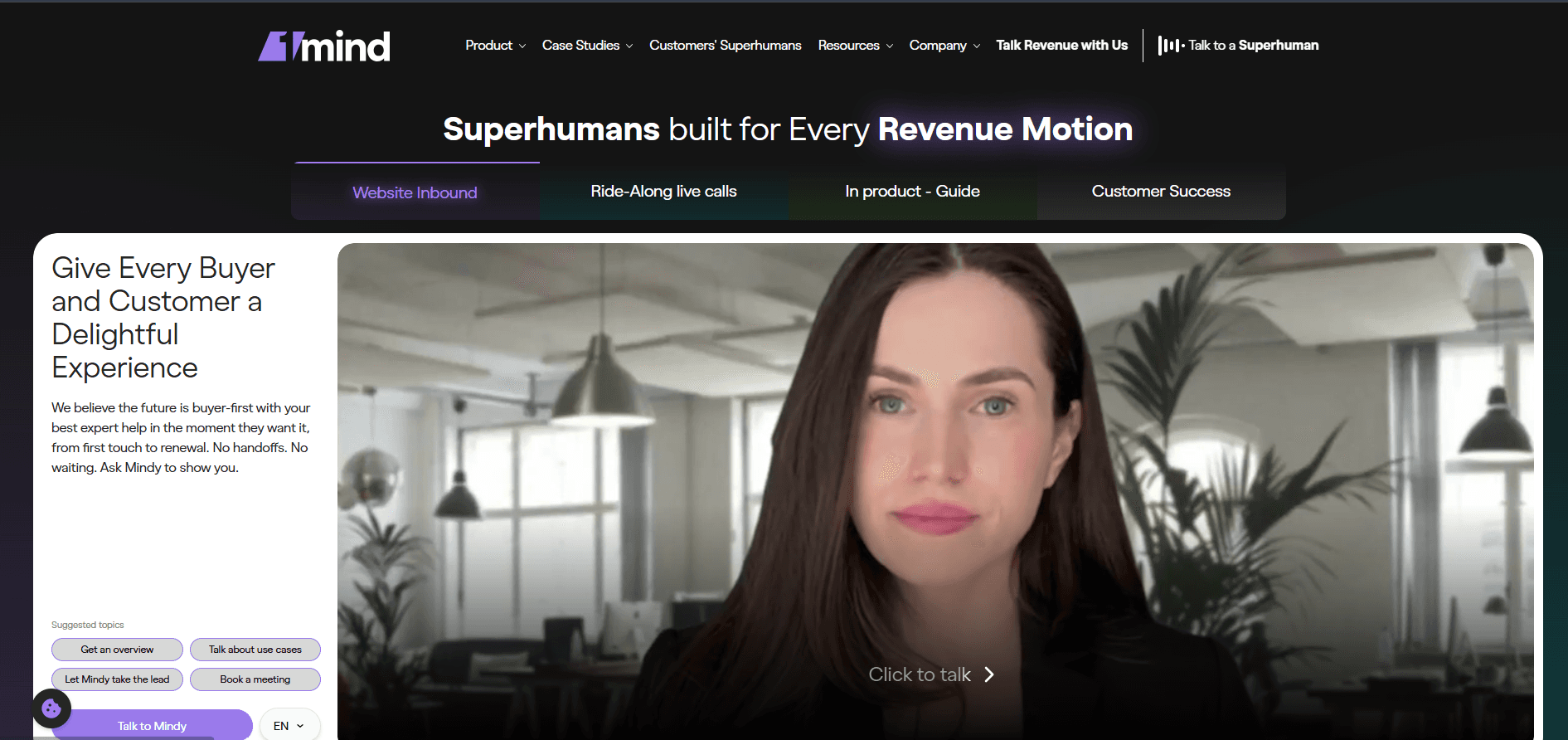
1mind calls its agents Superhumans and gives each one a human name. Four agent types share a single brain, carrying context from the first website visit through renewal. Each agent presents as a photoreal persona. In March 2026 Salesloft moved its Chat Agents product from Drift to 1mind.
Key Features
Ride-Along Superhuman: The agent joins live sales calls as an active participant and answers technical questions, covering AE and partner calls without an SE present.
One Brain Across Four Motions: Website, in-product, live call, and customer success agents share context across the funnel.
Pricing
No published figures, so pricing is quote-based. Third-party blogs cite annual contract ranges with no primary source behind them.
Where 1mind Shines
Funnel breadth on one context layer: Four agent types running on a single brain.
Live-call coverage: Technical answers on calls with no SE in the room.
Published head-to-head metrics: 1mind cites a 16x ROI in three months and a 77.6% win rate against 53.6% on Drift.
Where 1mind Falls Short
Avatar-led format: Buyers watch a persona rather than clicking through the software, which is where Hobbes and 1mind part ways.
Wider implementation surface: Four motions require more scoping than a single website agent.
Thin third-party coverage: Neutral review-platform volume trails the customer list, leading many buyers to explore 1mind alternatives before committing.
Customer Reviews
Praise centers on the live-call agent and on technical answers delivered without an SE. Named executives appear in video testimonials on 1mind's site. Independent coverage is thin enough that GetApp's 1mind listing carries no reviews at all, so most available feedback is vendor-published.
Who 1mind Is Best For
Enterprise GTM teams buying a full-funnel program: One vendor from first touch to renewal.
Salesloft customers: 1mind is the chat agent Salesloft now points to.
3. Qualified: Best for Salesforce Shops at Enterprise Volume
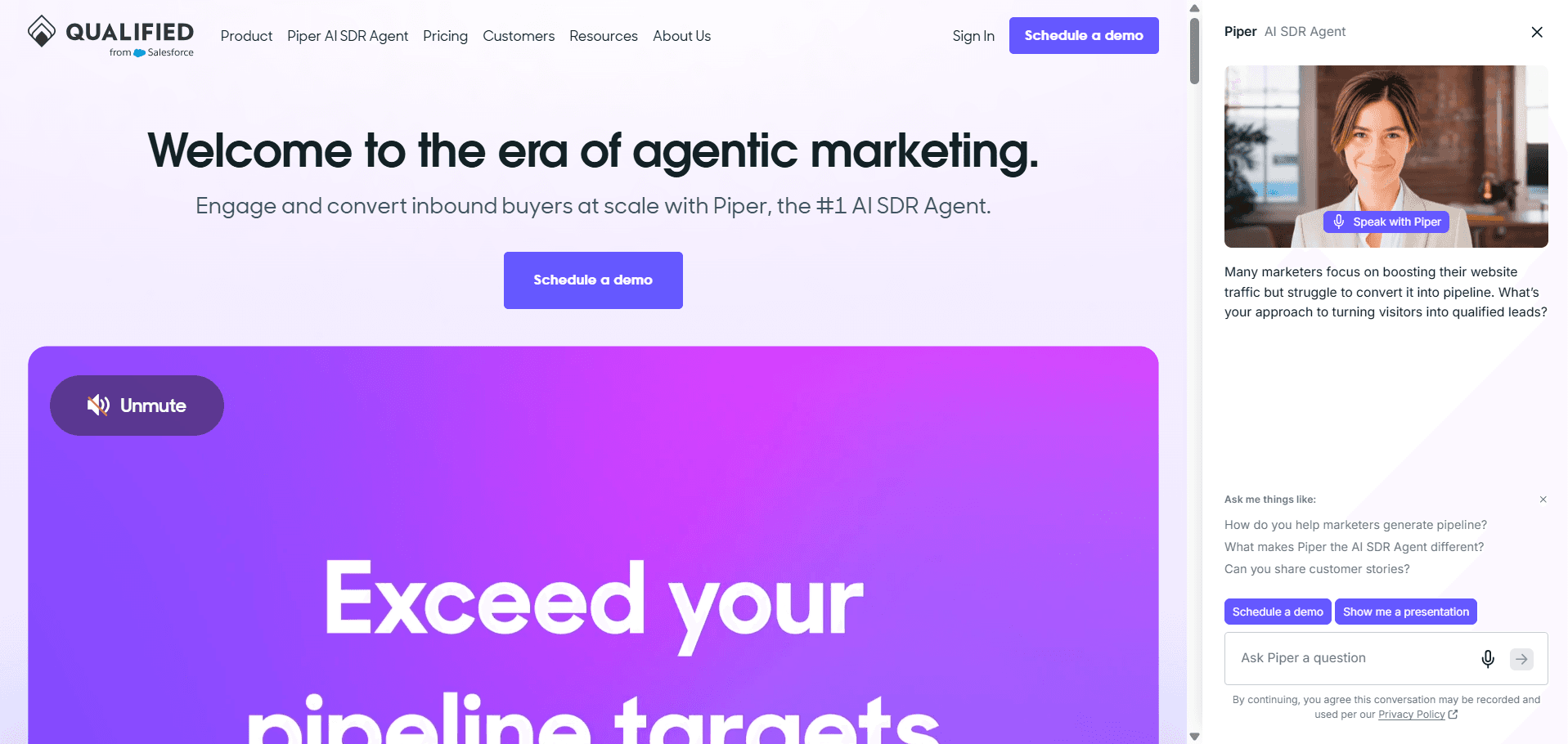
Qualified's agent, Piper, engages website visitors, answers questions, and books meetings. Salesforce completed its acquisition on April 1, 2026, a deal its filings value at $1.2 billion, and Piper is being folded into Agentforce.
Key Features
Multi-Modal Website Conversations: Piper engages in text, voice, and video, runs agentic email conversations, books meetings, and supports multiple languages. Qualified reports more than 500 customers.
Capacity Metered in Web Sessions: Plans size by monthly web sessions and active email contacts rather than by seats.
Pricing
Every tier is quote-based, and capacity is what separates them.
Tier | Capacity | Price |
Premier | 250,000 monthly web sessions, 2,500 active email contacts | Contact sales |
Enterprise | 2 million sessions, 10,000 contacts, plus agent handoff and API access | Contact sales |
Ultimate | 5 million sessions, 24,000 contacts, plus multiple agent profiles | Contact sales |
Where Qualified Shines
Salesforce integration: Native CRM data in the conversation, under the same owner as the CRM.
Enterprise traffic capacity: Tiers run to 5 million monthly sessions.
Review volume: Qualified cites more than 1,800 five-star reviews and a 2026 Best Software Award.
Where Qualified Falls Short
No product experience: Piper answers questions about the software. Seeing it work requires a rep, and that's the core split in Hobbes vs Qualified.
Ownership in flux: Roadmap decisions now sit inside Agentforce.
Enterprise-only economics: No published figures, no self-serve path, and implementation assumes a Salesforce admin.
Customer Reviews
Piper rates 8.9 out of 10 across 37 reviews on TrustRadius, where praise centers on lead qualification, routing, and the Salesforce integration, and on engaging visitors in their own language. The same reviewers report Piper struggling with unanticipated questions, occasionally attempting tasks it cannot complete, and making multilingual setup cumbersome. Community discussion divides on whether the price fits below enterprise.
Who Qualified Is Best For
Enterprise marketing teams on Salesforce: The admin, traffic, and budget are already in place.
Teams reporting in sourced pipeline: Qualified's analytics are built around sourced pipeline.
4. Fin: Best for Support and Sales in One Inbox

Fin was called Intercom until it rebranded in May 2026. Its AI agent resolves questions across live chat, email, WhatsApp, SMS, phone, and Slack, and its plans cover service, sales, and ecommerce. Salesforce signed a definitive agreement to acquire Fin for approximately $3.6 billion on June 15, 2026, with closing expected in its fiscal Q4 2027.
Key Features
Outcome-Based Billing: Fin charges from $0.99 per outcome rather than per conversation and runs on an existing helpdesk with no seats required.
Omnichannel Coverage: One agent covers six channels and hands off to humans in the team's existing inbox.
Pricing
Plan | Seat price | AI pricing |
Essential | $29 per seat/month | From $0.99 per Fin outcome |
Advanced | $85 per seat/month | From $0.99 per Fin outcome |
Expert | $132 per seat/month | From $0.99 per Fin outcome |
Fin standalone | No seats required | From $0.99 per Fin outcome |
Where Fin Shines
Largest review base in this list: More buyer feedback available than for any other tool here.
Channel coverage: Six channels on one agent, voice and WhatsApp included.
Helpdesk-agnostic: Fin runs on top of other helpdesks, Salesforce among them.
Where Fin Falls Short
Built for support: ICP scoring and routing to an AE sit outside the core product.
Variable billing: Seats plus per-outcome charges make the monthly total hard to forecast.
No product experience: Buyers who want to see the software still reach a form, which is the main gap when you compare Hobbes and Fin.
Customer Reviews
Speed and accuracy on repetitive questions draw the most praise, named by 435 reviewers on G2. Cost is the most common complaint, with 92 reviewers citing high pricing and unexpected bills. The per-outcome model attracts the sharpest criticism, since higher resolution volume raises the invoice.
Who Fin Is Best For
Teams fielding support and sales questions in one widget: One agent covers both.
Companies with a mature knowledge base: Fin's answers depend on existing content.
5. Handhold: Best for HubSpot Teams Running a Pilot

Handhold rebranded from Align in 2025. It runs product demos as a conversation and writes each interested visitor into HubSpot with the transcript attached.
Key Features
HubSpot-Native Handoff: Creates or updates the contact on demo completion, maps demo answers to contact properties you select, and logs the transcript as a meeting.
Qualification Without a Form: The agent collects visitor details during the conversation rather than through form fields.
Pricing
Starter is €299/month plus €3 per demo agent session, covering platform access, integrations, analytics, and unlimited Q&A sessions. Core adds in-product agents at no published price. The 14-day trial covers 30 sessions, and per-session rates drop at commitments of 100, 500, or 1,000 sessions.
Where Handhold Shines
Published entry price: One of the few conversational agents listing a starting figure.
Usage-based cost: Billing tracks session volume.
Free trial: 30 sessions with no commitment.
Where Handhold Falls Short
Per-session cost compounds: Fees scale with traffic, and the volume commitments that lower them require demand forecasting.
HubSpot-first: Integration depth sits in one CRM.
Limited track record: The HubSpot marketplace listing showed fewer than 10 installs and zero reviews as of August 2026.
Customer Reviews
No public reviews exist. The HubSpot marketplace listing carried zero as of August 2026, and Handhold does not appear in G2's Demo Automation category. Handhold only rebranded in 2025, so reviews have had little time to accumulate.
Who Handhold Is Best For
HubSpot-centric teams: Demo data lands in the CRM of record.
Teams running a paid pilot: A published price and a trial shorten procurement.
6. Navattic: Best for Turning Website Traffic Into Leads

Navattic built its reputation on marketing-led embedded tours with step-level analytics, and it has since added conversational agents priced on the number of conversations and agents, plus AI avatars and avatar cloning. The fit is demand gen teams that want interactive content on landing pages and step-level drop-off data.
Navattic has moved the opposite way from the rest of the market on pricing. The Starter tier is free for one seat and one demo, Base and Growth now show annual billing with no dollar figure attached, and Enterprise is custom. There's also a Startup plan for bootstrapped and seed-stage teams of 30 or fewer. Figures quoted in older ranking articles no longer appear on the page, so get a current quote.
7. Storylane: Best for Shipping Your First Demo Fast

Storylane publishes interactive demos quickly, with demo hubs organized by persona and CRM sync. A marketer can ship one without an engineering ticket, and it's the only tool in this group publishing a full price ladder.
The Free tier costs nothing, Starter runs $50/month monthly or $40/month annual, Growth jumps to $625/month monthly or $500/month annual, and Premium sits at $1,500/month monthly or $1,200/month annual. The HTML editor starts on Growth, which is where that jump bites. Storylane also sells RepX, a separate AI SDR line priced from $2,000/month.
8. Supademo: Best for Guided Demos on a Tight Budget

Supademo focuses on fast, low-cost demo creation and carries the lowest entry price in this list. The free tier covers five guided demos and 50 video recordings for one creator, Scale runs $50 per creator monthly or $38 annual, and Growth sits at $450/month monthly or $350 annual for five creators.
The AI Demo Agent is a prepaid-credit add-on rather than a plan feature, at roughly $0.06 per credit, which Supademo puts at about $1.25 per typical demo call. The credit model keeps the cost easy to forecast, though the conversational layer is an add-on to a tour product rather than the core of it.
How to Choose Conversational AI for Inbound Leads
Start with what the buyer gets to do, then follow the handoff, then ask who'll own the vendor at renewal. Most teams never get to the third question.
What Does the Buyer Actually Get to Do?
Gartner surveyed 646 B2B buyers between August and September 2025 and found that 67% prefer a rep-free experience. A buyer who skips the call still wants to see the thing work.
Chat agents answer questions about a product. A browser agent can also guide the buyer through the product itself. For software with multiple personas and workflows, evaluate the visible product guidance, the quality of answers, and the allowed action boundaries together. Hobbes supports text and voice conversations with a live product or prepared experience. Learn more about how conversational AI is changing B2B sales.
How Does a Qualified Buyer Reach a Rep?
Gartner's May 2026 research found that 69% of B2B buyers turn to sales reps to validate AI-generated insights, even as 70% say they'd prefer a completely digital, self-service purchase. Buyers want both, in that order. Self-service first, then a human to check the work.
So interrogate the handoff rather than the chat quality. Does the agent enrich the contact? Does it score against criteria you define, or against a generic lead score? Does the transcript reach the rep before the call does? Hobbes enriches, scores against your own ICP criteria, and pushes the conversation into your CRM, so the rep opens the record already knowing what the buyer asked and where they hesitated.
Watch that handoff happen on a live agent and Start Demo with your own questions.
Who Owns This Vendor in Two Years?
Salesforce closed on Qualified in April 2026 and signed for Fin in June. Salesloft swapped Drift for 1mind in March. Three of the biggest names in conversational AI for inbound leads changed hands or changed partners inside nine months.
Those deals may well leave Agentforce buyers better served. But an agent whose roadmap now belongs to a CRM vendor you also negotiate with weakens your hand at renewal. Ask every vendor who owns the roadmap, what the migration path looks like, and what happens to pricing at renewal. The honest ones will tell you. Either way, conversational intelligence keeps your transcripts and objection data in your own systems.
Turn Visitors Into Customers With Hobbes
Every tool here is conversational AI for inbound leads. What separates them is whether a buyer who lands at 2 a.m. sees your product today or waits three days for a calendar link. Complex software, reps burning hours on first calls that go nowhere, and a form sitting where a demo should be all point the same direction. Put an agent on the site that runs the demo, answers the hard questions, and books only the buyers who fit. Talk to Hobbes and watch it demo itself first.
FAQs
1. What Is Conversational AI for Inbound Leads?
Software that engages website visitors, answers product questions, and helps qualify or hand off the visitors who fit. Hobbes pairs that conversation with product guidance in a live product or prepared experience.
2. Can Conversational AI Replace an SDR Team?
No. Hobbes replaces the demo request form and the first qualification call, not the reps. Gartner's 2026 research found most B2B buyers still want a human to validate what AI tells them.
3. How Long Does It Take to Launch a Conversational AI Agent?
Launch timing depends on product access, source readiness, integration needs, and review. Agree on the rollout scope, test representative conversations, and verify the published visitor experience before launch.
4. Does Conversational AI Work for Buyers Outside English?
Hobbes supports configured language and voice experiences. Confirm the exact locale and voice needed for your rollout, and test them with representative questions. A translated product view has separate readiness and publication checks.
5. How Do You Measure Conversational AI Performance on Inbound?
Measure meetings booked and pipeline created rather than conversations started. Track qualified conversion rate against your ICP criteria, meetings booked per thousand sessions, and how many survive to a second call.
For product details, read the Hobbes inbound demo guide.
Chirag Kulkarni
Co-Founder, Hobbes
Chirag Kulkarni is the co-founder and CEO of Hobbes, an AI company building autonomous, conversational product demos for B2B software companies. Before Hobbes, he worked at McKinsey, built AI tools for the Pentagon, and held strategy and operations roles at high-growth startups.



Get a Demo

how to Improve User Onboarding and Stop Losing Customers
To improve user onboarding, define your activation milestone, find where users drop off, fix the biggest friction point first, then test each change by cohort.
12 User Onboarding Best Practices for SaaS (2026)
The best user onboarding practices are defining one activation milestone, personalizing by role, revealing features gradually, and tracking activation
15 min read
5 Best User Onboarding Software for SaaS Products (2026)
The best user onboarding software: 1. Hobbes 2. Userpilot 3. Appcues 4. Userflow 5. Pendo. See features, pricing & more.
17 min read
7 Best Consensus Alternatives for B2B SaaS in 2026
The top Consensus alternatives are Hobbes, Reprise, Walnut, Storylane, Navattic, and Demostack, differing in format, setup time, personalization, and pricing.
7 Best 1mind Alternatives Reviewed for B2B SaaS in 2026
Compare 1mind alternatives for B2B SaaS, including interactive demos, AI product experiences, pricing, key features, and best-fit use cases
8 Best Supademo Alternatives for B2B SaaS Teams in 2026
The top Supademo alternatives are Hobbes, Storylane, Navattic, Arcade, Walnut and Consensus, differing on format, AI depth, analytics and per creator pricing.
8 Best Demostack Alternatives for B2B SaaS Teams in 2026
The top Demostack alternatives are Hobbes, Reprise, Walnut, Storylane, Navattic and Consensus, differing on format, setup time, personalization and pricing.
21 min read
Demo Automation Guide: Steps, Tools and 2026 Benchmarks
Demo automation is the use of software to run product demos without a rep on every call, from recorded walkthroughs to AI agents that demo the live product and qualify buyers.
13 min read
SaaS Product Demo 2026: Software, Examples & Best Practices
A SaaS product demo shows a buyer your product solving their problem. Compare five formats, build one in five steps, and use the 30-minute call script.
17 min read
8 Best Product Demo Software Platforms for SaaS Teams in 2026
The best product demo software includes Hobbes, Storylane, Navattic, and Reprise, spanning conversational, tour, sandbox, and live overlay formats.
Experience a Demo
Ready to see Hobbes in Action?
Designed for teams who need control, consistency, and measurable impact across every demo touchpoint.