Chirag Kulkarni
Co-Founder, Hobbes
Chirag Kulkarni is the co-founder and CEO of Hobbes, an AI company building autonomous, conversational product demos for B2B software companies. Before Hobbes, he worked at McKinsey, built AI tools for the Pentagon, and held strategy and operations roles at high-growth startups.
Key takeaways
Hobbes is the best 1mind alternative for B2B SaaS teams whose buyers want to click through the product before talking to anyone. Skip it if a buyer understands what you sell in 30 seconds.
Supersonik is the pick for teams that want a voice agent driving their live software.
Navattic and Storylane are the marketing-led picks, Navattic for website lead capture, Storylane for getting a demo live this week.
Consensus is best for enterprise teams selling to buying committees, and it now owns Saleo's AI demo agent.
Supademo and Naoma are the lighter tests, Supademo for demos that also serve support and onboarding, Naoma for an avatar-led agent bought without a sales call.
Every 1mind alternative here shows your product without making the buyer wait for a rep. The tools split on what the buyer looks at while the agent talks. 1mind puts a persona on the screen. Hobbes puts the product on it.
What fills the screen matters more than it sounds, because 94% of buyers who use AI fact-check its answers, according to TrustRadius' 2026 survey of 1,862 technology buyers. A buyer who checks everything would rather click through your software than take an agent's word for it.
Supersonik, Navattic, Storylane, Consensus, Supademo, and Naoma each put something different on that screen, from agents that drive your live app to tours a marketer ships in an afternoon.
Quick Comparison of the Best 7 1mind Alternatives
We built this shortlist from the 1mind competitors that appear most often across published alternatives roundups and software directories, then checked each vendor's own pricing page and review profile. Where a vendor publishes no price we say so, which is why the six-figure contracts several blogs quote for 1mind stay out of the table below.
Tool | Best for | What the buyer sees | Stand-out feature | Starting price |
Hobbes | Buyers who explore your product themselves | An interactive sandbox of your product | ICP scoring and CRM routing on every conversation | Contact sales |
Supersonik | Demos driven on your live software | Your live product, driven by a voice agent | A dedicated forward deployed engineer per deployment | Contact sales, private offer only |
Navattic | Turning website traffic into leads | HTML capture tours and sandbox demos | Account identification and A/B testing | Free; paid tiers contact sales |
Storylane | Shipping your first demo fast | Screenshot, video, HTML, and sandbox demos | Demo hubs segmented by persona | Free; paid from $40/month billed yearly |
Consensus | Selling to large buying committees | Video, tours, and live demos with data injection | Stakeholder-level demo intelligence | Contact sales |
Supademo | Demos that serve more than sales | Guided interactive, HTML, and sandbox demos | Prepaid agent credits that never expire | Free; paid from $38/creator/month billed yearly |
Naoma | Trying an avatar-led agent self-serve | Slides on Starter, your live product from Growth | Billing that only counts demos past three minutes | From $249/month billed yearly |
Pricing moves often in this category, so confirm current figures with each vendor.
Most tools here help you build a better demo, or put a face in front of one. Hobbes runs the demo on your product and hands your reps a buyer who already fits. Put your hardest buyer question to it right now, because Hobbes runs a live demo on itself, so Talk to Hobbes and watch the answer arrive with the product on screen.
1. Hobbes: Best for Buyers Who Explore Your Product Themselves

Your best demo shouldn't depend on which rep is free. Hobbes is an AI product agent, running on your website as an AI employee for sales, covering the demos your team never gets to run.
Against 1mind, Hobbes changes what the buyer sees, who steers, and what reaches your reps.
Your product on the screen: Buyers click through an interactive sandbox of your product, where 1mind's persona, which it calls the Superhuman, talks them through it.
The buyer steers: They ask by text or voice, and the matching product view opens as Hobbes answers.
Reps get a qualified buyer: Enrichment, ICP scoring, CRM context, and a booked meeting.
The visitor at 2 a.m. gets your software to poke at, and your reps learn whether they're worth a call.
Hobbes Key Features
Hobbes runs on your website for inbound demand and through Hobbes Links, personalized demo links for outbound campaigns and follow-ups.
#1. An Interactive Sandbox of Your Product so That Buyers See It Work
Point Hobbes at your product and the first sandbox can be standing inside an hour. No engineering ticket, and the captures update themselves when your UI changes next sprint.
Hobbes builds it from live product capture plus your docs, help center, sales decks, and recorded sales calls, so it already knows how your team explains the thing.
The buyer or the agent can take each session down a tailored path, so a RevOps lead and a CFO walk away from two different demos.
#2. A Buyer-Led Conversation so That No Two Demos Feel the Same
Buyers ask anything they want, by text or voice, and Hobbes answers with the relevant product view already open. There's no avatar, a deliberate call rather than a missing feature, so the screen stays yours.
Hobbes researches each visitor's company in real time and adapts the demo to their role and use case, in 30+ languages, translating the conversation and your product interface into the terminology that region uses. Conversational intelligence logs every transcript, product heatmap, and objection, so your team sees where buyers stall.
#3. Live Qualification and Routing so That Reps Only Meet Real Buyers
While Hobbes walks a buyer through the demo, it's quietly doing the homework a rep usually only gets to on the first call, enriching the contact with LinkedIn, phone, and company data and scoring them against the ICP criteria you set.
The moment intent is clear, Hobbes offers a calendar or checkout and routes the buyer to the right rep, with the transcript and the score already in HubSpot, Salesforce, Attio, or Pipedrive.
For lower-ACV deals it can run the deal from discovery to close. After the sale, the same agent onboards new users in a sandbox and helps existing customers try the next use case when they engage.
Reps only meet real buyers.
Hobbes Pricing
Plan | Price | What's Included |
Starter | Contact sales | Conversational agent and sandbox, core analytics, native CRM integration, webhooks, dedicated Slack channel |
Growth | Contact sales | Adds qualification scoring, objection tracking, people enrichment, a named implementation manager, API and MCP |
Scale | Contact sales | Adds whitelabeling, agent-driven product refresh, a named customer success manager, priority support, GitHub sync |
Custom | Contact sales | Adds SSO and SAML, security review, custom DPA, data residency, an SLA, and a dedicated solutions engineer |
Compare what each tier includes on the Hobbes pricing page.
Where Hobbes Shines
An interactive sandbox of your product, live fast: The first sandbox can be ready within an hour with no engineering, and the captures refresh themselves as you ship.
A fully dynamic product experience: The buyer or the agent walks the product down a tailored path, so no two demos feel the same.
A self-improving agent: It simulates real buyer scenarios before launch, flags what it can't answer instead of guessing, re-reads your docs and help center as they change, remembers returning visitors, and sharpens with every conversation.
Qualification, not engagement: Enrichment, ICP scoring, and routing mean reps get a briefed buyer rather than a view count.
Coverage in every hour and region: Hobbes runs 24/7 in 30+ languages, translating the conversation and your product interface. No lead waits overnight.
Managed implementation: You go live in days, with simulations, evaluations, and ongoing optimization included rather than quoted as services.
Where Hobbes Falls Short
Overkill for simple products: A buyer who understands your product in 30 seconds doesn't need a conversation, and a guided tour will cover it faster.
It needs your input to stay accurate: Hobbes wants product access, source materials, and an owner on your side to review and approve what the agent says.
Hobbes Customer Reviews
Praise clusters around what happens after hours, and the numbers come from named customers rather than a review wall.
Take Sutton, formerly Digit. Their website pulled traffic, but the demo request form was the only way in.

After Hobbes, CRO Simon Kronenberg watched human bookings jump 53%. In his words, "Hobbes has seriously increased the number of qualified leads from our website." Read the full Sutton story.
HyperSpell doubled revenue in six weeks on an 82% qualified conversion rate against its own ICP criteria, and founder Conor Brennan-Burke went in reluctant.

His verdict afterward was short. "I don't think I'll ever go back to doing things the old way." At SalonScale, 64% of Hobbes demos ran outside business hours.
Who Hobbes Is Best For
Marketing leaders who own website conversion: CMOs, VPs of Marketing, and heads of demand gen turning anonymous traffic into qualified pipeline.
Sales leaders running a demo-heavy motion: CROs, RevOps, and SE leaders who want reps meeting only real buyers, and their hours back from repeat first demos.
Mid-market B2B SaaS with complex products: Roughly 51 to 5,000 employees, $5K+ ACV, and more than one buyer persona.
Teams leaving 1mind over what fills the screen: Anyone who'd rather a prospect clicked through the software than watched a persona discuss it.
Your first sandbox can be standing inside an hour and your agent goes live in days, so See your Agent running on your own product before you commit to anything.
2. Supersonik: Best for Demos Driven on Your Live Software
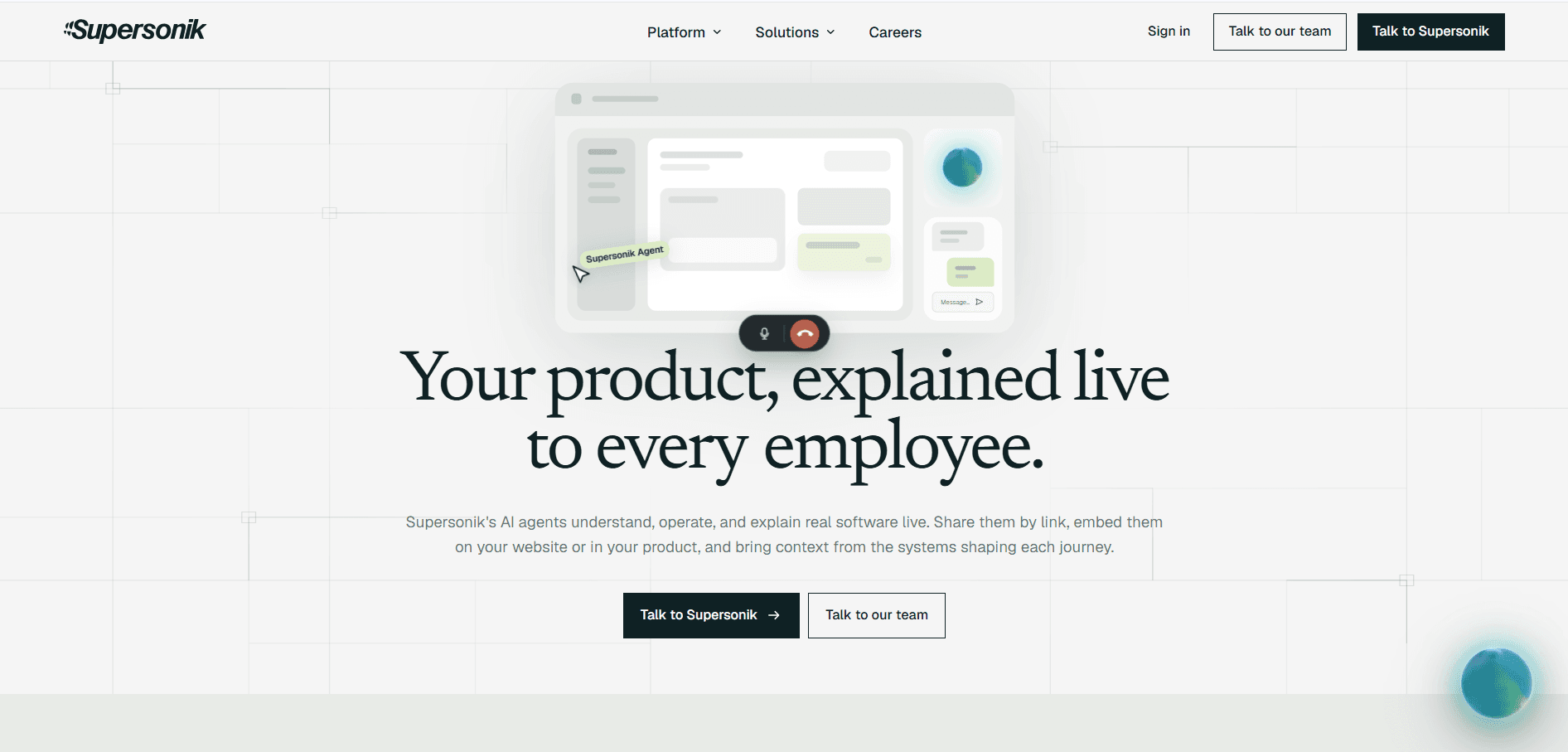
Supersonik deploys voice agents that operate your actual product, navigating the UI, answering questions, qualifying the lead, and personalizing the session from CRM data. That makes it the closest like-for-like swap here for teams who liked 1mind's conversational depth but wanted the software itself on screen.
Key Features
Agents That Operate Your Live Product: The agent drives your real UI in a voice session, adapting to what the user asks to see.
42 Prebuilt GTM Workflows: Journeys across presales, onboarding, adoption, enablement, and expansion, with context from 500+ connected systems.
A Dedicated Forward Deployed Engineer: One engineer owns discovery through production and keeps optimizing after launch, included in the platform fee.
Pricing
Supersonik publishes no figures and sells exclusively through private offers, each scoped to your product and volume. Rollout runs in phases from discovery through alpha and beta to production, and your subscription only starts once success criteria are validated. Figures on its AWS Marketplace listing are marked as placeholders.
Where Supersonik Shines
Product fidelity: The buyer watches your live software rather than a capture of it.
Pre-launch testing: Agents face expected, ambiguous, and adversarial sessions before production.
Hands-on implementation: A named engineer per account, and a subscription that waits for proof.
Where Supersonik Falls Short
No way to try it yourself: No published price, no self-serve plan, and a phased rollout before you're live.
Thin public evidence: No G2 profile and few third-party reviews, so reference calls do the work.
Driving production software: An agent operating your live app raises demo-account and data questions a sandbox sidesteps.
Customer Reviews
Public review coverage is close to nonexistent, so the useful sentiment sits in practitioner threads. On r/salesengineers, one SE saw a fit "for SMB sales where maybe the buyer has already used a popular product," while arguing enterprise deals "are built on relationships, trust, and mutual effort."
Who Supersonik Is Best For
Teams with a product too intricate to capture: Workflows that only behave correctly in the live app.
Enterprises that want a vendor-side engineer: Buyers who prefer a managed deployment over a tool they configure.
Learn more about what an AI demo agent does differently from a tour.
3. Navattic: Best for Turning Website Traffic Into Leads

Navattic is a no-code platform built on HTML capture, with some of the strongest marketing analytics in the category. In 2026 it added Navattic Agents, which guide and qualify prospects, answer questions, and demo key workflows in real time, sold on top of the Base plan.
Key Features
HTML Capture Tours: Interactive demos you embed on your site, with sandbox demos on the Growth plan.
Funnel Analytics Tied to Pipeline: Account identification, A/B testing, interest areas, and pipeline impact reporting.
Navattic Agents and AI Avatars: Agents priced by conversations and agents, plus avatar minutes and avatar cloning on higher tiers.
Pricing
Plan | Price | Notes |
Starter | Free | 1 seat, 1 demo (HTML or media), basic analytics |
Base | Contact sales | 5 seats, unlimited HTML demos, account identification, A/B testing, MCP server |
Growth | Contact sales | 10 seats, sandbox demos, demo translation, SSO, AI avatar cloning |
Enterprise | Custom pricing | Offline demos, audit logs, professional services |
Startup | Contact sales | Bootstrapped and seed-stage teams of 30 or fewer |
Agents | Contact sales | Priced by conversations and agents, includes Base plan access |
Base and Growth are billed annually, and only the free tier carries a figure. Older roundups still quote $500 a month for Base, a figure no longer on Navattic's page.
Watch Out: Three tools here sell sandbox demos, so check what the word covers before you compare. Navattic gates them to Growth, Storylane to Enterprise, and Supademo to its $350 tier, which puts the format well above each entry plan. Hobbes carries the sandbox from its Starter tier and builds it for you from live product capture plus your docs, help center, sales decks, and recorded sales calls.
Where Navattic Shines
Step-level analytics: Marketers see exactly where demo viewers drop off, by account.
Website conversion focus: Nothing here is more tuned for embedding demos that capture leads.
A free tier that works: One live demo with unlimited views is a real test rather than a teaser.
Where Navattic Falls Short
Recapture work: Captures are copies of your product, so UI changes mean recapturing as your library grows.
Opaque paid pricing: You can't compare plans without a sales call.
Agents are new: The conversational layer arrived in 2026 and is priced separately from the plan it sits on.
Customer Reviews
Navattic holds 4.8/5 from 1,115 reviews on G2, where praise clusters tightly on support quality and how little code the tool needs. The recurring complaint is navigation depth, with SE manager Shaquille B. noting "too many buttons and pathways to achieve your objective as a user." On r/ProductMarketing the dissent is cost as seats grow.
Who Navattic Is Best For
Product marketing and growth teams: Teams running top-of-funnel demos on the website.
Data-driven marketers: Anyone who wants account-level demo analytics tied to pipeline.
See how two of the tour leaders compare in our breakdown of Storylane vs Navattic.
4. Storylane: Best for Shipping Your First Demo Fast

Storylane gets a non-technical marketer from zero to a published demo in an afternoon, and it publishes its prices, which almost nobody in the agent category does. It has grown beyond tours, with HTML capture on Growth, sandbox demos on Enterprise, demo hubs by persona, and RepX, a separate line of conversational AI agents over video, voice, and text.
Key Features
Demo Formats That Grow With Your Team: Screenshot, video, HTML capture, Figma-to-demo, and Enterprise sandboxes.
Hubs and Personalization: Persona-based demo hubs, personalization tokens, and A/B testing on Growth.
RepX Conversational Agents: A separate product line of agents that answer questions, qualify buyers, and book meetings.
Pricing
Plan | Monthly Billing | Yearly Billing | Notes |
Free | $0 | $0 | 1 seat, 1 published demo at a time |
Starter | $50/month | $40/month | 1 seat; extra seats $40 |
Growth | $625/month | $500/month | 5 seats, HTML editor, A/B testing |
Premium | $1,500/month | $1,200/month | 10 seats, Hubs, SSO, multi-language demos |
Enterprise | Contact sales | Contact sales | Adds sandbox demos, API, professional services |
RepX is priced separately from the Demo Suite tiers above, so confirm both lines if you want the agent.
Where Storylane Shines
Ease of use: Its most-mentioned strength by a wide margin, and the reason teams ship in days.
Published tiers: Rare in this set, and useful when you need a business case approved.
Format range: You can start on screenshot tours and grow into HTML and sandbox demos without switching vendors.
Where Storylane Falls Short
Plan gating: The HTML editor starts on Growth and sandboxes on Enterprise, so fidelity arrives well above the entry tier.
Managing demos at scale: Demo management and customization limits are the top complaint tags on G2.
Two product lines to buy: Demo Suite and RepX are quoted separately.
Customer Reviews
Storylane holds 4.7/5 from more than 1,600 reviews on G2. Praise clusters on speed and polish, with Abril V. writing "I love how easy is to use the tool, and how the demos end up looking amazing." Complaints cluster on seat and plan limits rather than the editor, and practitioners on r/ProductMarketing note you're largely on your own to implement.
Who Storylane Is Best For
Startups and small marketing teams: Teams that want a published demo this week without a sales call.
PMM teams running launches: People who need demos for launch pages, emails, and campaigns.
Weighing it against the rest of the field? Read our breakdown of Storylane alternatives.
5. Consensus: Best for Selling to Large Buying Committees

Consensus started in video-first demo automation and now runs the broadest suite in this comparison. A rep sends one demo, every stakeholder who opens it gets a version weighted toward what they care about, and Demo Intelligence reports who inside the account engaged with what. Its agent capability arrived by acquisition, when Consensus acquired Saleo in June 2026 and brought in Saleo's AI Demo Agent, which runs autonomous conversational demos and navigates the product in real time.
Key Features
Per-Stakeholder Demo Intelligence: Engagement mapped across a whole buying group rather than a single contact.
Saleo's AI Demo Agent: Autonomous demos that answer buyer questions and navigate the product, with demo data injected.
Four Formats in One Platform: Interactive tours, video, AI agents, and live demos in a single continuous experience.
Pricing
Consensus doesn't publish figures. Its pricing page describes per-user licenses plus optional usage-based capabilities, quoted through a form, with integrations included and no free plan. On its own site it reports customers seeing 50% larger deal sizes, 2x more deals, and 30% shorter sales cycles. With two acquisitions closed in 2026, ask how Saleo and Peel will fold into the core product on your timeline.
Where Consensus Shines
Committee visibility: Nothing else here maps a six-person buying group as well.
Format breadth: Video, tours, live demos, and agents under one contract.
Where Consensus Falls Short
The buyer mostly watches: Products that resist scripting hit that ceiling fastest.
Interface complexity: Reviewers flag the UI, and two acquisitions add more surface to learn.
No published price or free plan: Every evaluation starts with a form.
Customer Reviews
Consensus holds 4.7/5 from 1,868 reviews on G2, and it self-describes as the highest-rated demo automation solution there. Praise clusters on time saved, with one VP of Solutions Engineering noting that showing part of the product "without having to get on another call" changed how her team works. The recurring complaint is the interface, where one VP of Presales wrote that "the UI has been unnecessarily confusing."
Who Consensus Is Best For
Enterprise presales and SE teams: Teams selling into committees of six or more stakeholders.
Teams standardizing on one vendor: Buyers who want video, tours, and agents on a single contract.
6. Supademo: Best for Demos That Serve More Than Sales

Supademo is genuinely good at fast, accessible demo creation, and its reach past the sales team sets it apart here. The same guided demos run in help docs, onboarding flows, internal training, and an LMS, which suits teams where product education and sales enablement sit with the same two people. Its AI Demo Agent runs voice-led sessions in 50+ languages, qualifies visitors, routes them to the most relevant approved demo, and hands reps a summary and transcript.
Paid plans start at $38 per creator a month billed yearly, rising through $199 and $350 tiers that add HTML editing, sandbox demos, and voice cloning, and the free plan covers five demos. The agent is a prepaid credit add-on rather than a plan feature, at about $1.25 per typical 15-minute call by Supademo's own math. It holds 4.7/5 from more than 650 reviews on G2, where ease of use dominates the praise and depth on complex products is the recurring limit. Supademo fits cross-functional teams that need demos in several places at once.
7. Naoma: Best for Trying an Avatar-Led Agent Self-Serve

Naoma answers 1mind's two biggest objections directly, because it publishes its prices and you can start without talking to anyone. Agents run demos around the clock in 80+ languages with photorealistic avatars, and billing only counts a demo when a prospect stays past three minutes, so bounces and misclicks don't land on your invoice.
Starter runs $249 a month billed yearly for 50 engaged demos, built from your slides and screenshots. The live product walkthrough, where the agent drives your actual software, starts on the $750 Growth plan, and $2,083 Scale adds branching paths and a dedicated demo engineer. Public review coverage is thin, with no G2 profile to check, so a trial on your own traffic is the only real evidence. Naoma suits teams who specifically want a face on screen and want to test that format before an enterprise scoping exercise.
Reasons to Consider an Alternative to 1mind
1mind is a serious product. Founded by 6sense founder Amanda Kahlow, it has raised $40 million, including a $30 million Series A led by Battery Ventures, and Clari + Salesloft named it the exclusive AI successor to Drift in March 2026. Four things still deserve a hard look.
1. There's No Published Price and No Self-Serve Way In
1mind publishes no pricing and offers no free trial, and the six-figure estimates in circulation trace back to no primary source. TrustRadius found that transparent pricing has been buyers' number one wish-list item four years running.
Hobbes is quote-based too. The difference is you can test the format tonight, because Hobbes runs a live demo on its own product.
2. The Buyer Watches a Persona Instead of Exploring Your Product
1mind's bet is the Superhuman itself, a photorealistic, stylized, or voice-only persona, and done well that's compelling. The session is still a conversation about your product rather than time inside it, and two-thirds of B2B buyers now prefer a rep-free experience, per Gartner's survey of 646 buyers.
With Hobbes, the buyer clicks through an interactive sandbox of your product while the agent answers whatever comes up.
3. Four Agent Types Across Four Motions Is a Bigger Scoping Job
1mind runs website, ride-along, in-product, and customer success agents on one shared Brain, and the ride-along agent that joins live calls is a genuine differentiator nothing else here matches. Launching it means aligning marketing, sales, presales, and customer success first, and integrations concentrate on the Clari + Salesloft stack.
Hobbes starts narrower, with one agent on your website and a four-step onboarding of train, simulate, launch, and improve that gets most accounts live in days.
4. One Wrong Answer Can Cost You the Deal
1mind's own CTO Sachin Bhat names the hard part. An enterprise-grade agent needs accuracy, breadth, and latency at once, and "all three at once is the actual engineering problem." One sales engineer on r/salesengineers put the stakes plainly, saying a wrong answer "can blow up a deal, even a very small one."
Hobbes simulates buyer scenarios before launch, flags what it can't answer instead of guessing, re-reads your docs as they change, and sharpens with every conversation.
Pro tip: Run these tests on every tool you try out:
Ask the question your current demo keeps failing to answer, not the happy path.
Ask what lands in your CRM after one session. A view count means your reps still start discovery from scratch.
Ask what happens the sprint after your UI changes, and get the answer in writing.
Our breakdown of how personalized demos affect conversion rates covers what to measure once the agent is live. See what your own agent would say to your hardest buyer question, then Train Your Agent on your docs and decks before you compare another feature list.
Pick the Right 1mind Alternative by What Fills the Screen
Every tool listed replaces something, whether that's a form, a tour, or a repeat first call. Choose by what your buyer looks at while the agent talks. Live software driven by a voice agent means Supersonik. Marketing-led tours mean Navattic or Storylane. Committees mean Consensus. A face on screen, bought self-serve, means Naoma.
If you want buyers clicking through your product and reaching reps already qualified, choose Hobbes and see the results in our customer stories.
FAQs
1. What Is the Main Difference Between 1mind and Hobbes?
What fills the screen. 1mind puts a persona with a face and a name in front of the buyer. Hobbes puts an interactive sandbox of your product on screen, lets the buyer click through it while asking questions, then scores them against your ICP and routes them to a rep.
2. Do AI Demo Agents Need a Photorealistic Avatar?
No. An avatar is a design choice. 1mind and Naoma lead with one, Supersonik leads with voice over your live software, and Hobbes skips it deliberately so the product occupies the screen. Hobbes still supports voice, so buyers can speak or type.
3. Can an AI Demo Agent Join a Live Sales Call?
Sometimes. 1mind's ride-along agent joins Zoom, Teams, and Google Meet calls as an active participant, and nothing else here does that today. Most agents, Hobbes included, run before the call, so the rep inherits a qualified buyer and a full transcript.
4. How Long Does It Take to Launch an AI Demo Agent?
Anywhere from an afternoon to a quarter. Storylane and Supademo can publish a tour the same day. Agent platforms take longer because they train on your product. Hobbes can stand up a first sandbox within an hour, and most accounts go live in days.
5. Which 1mind Alternatives Publish Their Pricing?
Storylane, Supademo, and Naoma. Storylane starts at $40 a month billed yearly, Supademo at $38 per creator, and Naoma at $249 a month. Navattic publishes a free tier, while Hobbes, Supersonik, and Consensus are quote-based. Learn more in our guide to product demo software.
Chirag Kulkarni
Co-Founder, Hobbes
Chirag Kulkarni is the co-founder and CEO of Hobbes, an AI company building autonomous, conversational product demos for B2B software companies. Before Hobbes, he worked at McKinsey, built AI tools for the Pentagon, and held strategy and operations roles at high-growth startups.



Get a Demo

8 Best Conversational AI for Inbound Leads (2026)
The best conversational AI for inbound leads: 1. Hobbes 2. 1mind 3. Qualified 4. Fin 5. Handhold. See features, pricing & more.
8 Best Supademo Alternatives for B2B SaaS Teams in 2026
The top Supademo alternatives are Hobbes, Storylane, Navattic, Arcade, Walnut and Consensus, differing on format, AI depth, analytics and per creator pricing.
8 Best Demostack Alternatives for B2B SaaS Teams in 2026
The top Demostack alternatives are Hobbes, Reprise, Walnut, Storylane, Navattic and Consensus, differing on format, setup time, personalization and pricing.
21 min read
Demo Automation Guide: Steps, Tools and 2026 Benchmarks
Demo automation is the use of software to run product demos without a rep on every call, from recorded walkthroughs to AI led sandbox demos that qualify buyers.
13 min read
SaaS Product Demo 2026: Software, Examples & Best Practices
A SaaS product demo shows a buyer your product solving their problem. Compare five formats, build one in five steps, and use the 30-minute call script.
17 min read
8 Best Product Demo Software Platforms for SaaS Teams in 2026
The best product demo software includes Hobbes, Storylane, Navattic, and Reprise, spanning conversational, tour, sandbox, and live overlay formats.
17 min read
Interactive Demo Benefits, Types, Tools & 3 Examples
An interactive demo lets buyers explore a product instead of simply watching a presentation. Learn how it works, its types, benefits, tools, and examples.
12 min read
What is an AI Demo Agent: How It Works and What to Look For
An AI demo agent runs a live, conversational product demo on your site and qualifies the buyer. See the three types, how they work, and what to look for.
17 min read
9 Best Product Tour Software Tools for SaaS Teams (2026)
Product tour software helps SaaS teams create interactive product experiences for onboarding or sales. Compare top tools and see where Hobbes fits
18 min read
Best Storylane Alternatives in 2026: 7 Tools Compared
The top Storylane alternatives include Hobbes, Navattic, Walnut, and Supademo, each fitting different demo formats, team budgets, and sales motions.
Experience a Demo
Ready to see Hobbes in Action?
Designed for teams who need control, consistency, and measurable impact across every demo touchpoint.